
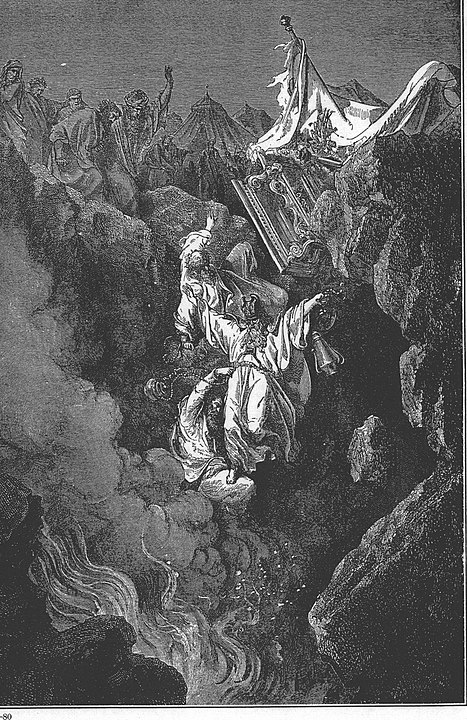

Korah’s Rebellion
The Book of Numbers is better understood in terms of its name in Hebrew: Bemidbar, “in the wilderness,” for it described Israel’s preparations to depart from Mount Horeb/Sinai and their wanderings in the wilderness afterward. The events described therein would have taken place sometime around either 1450-1410 or 1250 BCE, depending on one’s view of the Exodus; Moses would have written the original text while in the land of Moab across the Jordan River from Jericho.
The Book of Numbers began with great hope for the imminent fulfillment of the rest of what YHWH had promised to the fathers. The people were faithfully counted and organized, and the Tabernacle and its service fully consecrated and dedicated, in Numbers 1:1-10:10.
Yet Israel turned in fear and rebelled against YHWH and His purposes. The people murmured and complained again, and even Aaron and Miriam questioned Moses in Numbers 10:11-12:16. The ultimate rebellion, and its devastating consequences, came about on account of the spies and their bad report of the land of Canaan in Numbers 13:1-14:45. All the Israelites over twenty years old would die in the wilderness save Caleb and Joshua. The people acutely felt the judgment and condemnation of God.
YHWH attempted to reassure and warn the people through a series of commands in Numbers 15:1-41. But it would not be enough for Korah, Dathan, Abiram, On, and their associates.
Korah was a Levite of the family of Kohath; Dathan, Abiram, and On were Reubenites (Numbers 16:1-2). They rose up against Moses and Aaron, accusing them of presumption and arrogance: they argued the community was holy since YHWH was in their midst, and thus who were Aaron and Moses to exalt themselves over the people (Numbers 16:3)?
Moses fell to the ground upon hearing this, and then declared how YHWH would determine who really was His on the next day: Korah and his fellow rebellious Levites should take censers of incense, and YHWH would choose who was holy before Him (Numbers 16:4-7).
Much has been made regarding Korah’s claim regarding the holiness of the people. Many interpreters seem willing to lend it credibility, yet the result of the whole affair should cast great skepticism on the validity of the logic expressed. YHWH is certainly holy; the community has proven far less so. Korah’s complaint seemed to have far less to do with any real concern about the holiness of the community and much more to do about his own standing: Moses would go on to accuse the rebellious Levites of wanting the priesthood for themselves (Numbers 16:8-11).
Moses then attempted to address Dathan and Abiram (On, for unknown reasons, fell out of the narrative), but they would not come to him; they accused Moses of bad faith and leadership, having led them out of a land of “milk and honey” into a wilderness in which to die, and they had not been brought into another land of “milk and honey” (Numbers 16:12-14). Moses was angry and asked YHWH to have no regard for their offerings (Numbers 16:15).
Korah’s interests and Dathan and Abiram’s interests, therefore, seemed quite different. Some have alleged the Numbers author or editor conflated two different rebellions and their accounts, but we have no need to resort to such an explanation. Korah took advantage of the moment to give voice to the frustrations and aspirations of many among the Levites; Dathan and Abiram, as Reubenites, were perhaps frustrated by how their tribe was set aside in terms of leadership and nurtured aspirations of power for themselves. It would not be difficult to imagine how Korah, Dathan, and Abiram might find each other in this circumstance, and to rise up at the same time to provide each other strength and encouragement in doing so.
The next day, Korah and the 250 with him stood at the tent of meeting with their censers of incense, and the “whole community” was assembled with them and against Moses and Aaron; the glory of YHWH appeared before the whole community (Numbers 16:16-19). YHWH first commanded Moses and Aaron to step aside so He might consume the whole community; Moses and Aaron prostrated themselves and begged YHWH to not destroy the whole community on account of the sin of one person (ostensibly Korah; Numbers 16:20-22).
Then YHWH commanded Moses and Aaron to warn the Israelites away from the tents of Korah, Dathan, and Abiram (Numbers 16:23-26). While Dathan, Abiram, and their families stood outside of their tents, Moses made the declaration to all Israel: if Dathan and Abiram and their families died a natural death, YHWH was not with Moses; but if the earth opened up and swallowed them and their families and possessions whole, YHWH was thus testifying how they despised Him and had spoken presumptuously (Numbers 16:27-30). When Moses had finished speaking, the earth opened up and Dathan, Abiram, and their families were all consumed; fire came out from YHWH and consumed the 250 holding the censers (Numbers 16:31-35). The Israelites were afraid they would suffer the same fate (Numbers 16:34)!
YHWH then made what many would consider a surprising command: Eleazar ben Aaron was to take the censers from the condemned men and make hammered sheets from them to cover the altar (Numbers 16:36-38). Even though those who held them had sinned, and suffered for their transgressions, their censers were offered to YHWH and thus had been made holy and should be dedicated to Him. They would also serve as a witness and a warning for future Levites (Numbers 16:39-40).
The community, however, proved bitter and resentful regarding the entire situation: they murmured against Aaron and Moses and accused them of killing YHWH’s people (Numbers 16:41). The glory of YHWH again appeared before the people, and YHWH again was about to consume the whole people (Numbers 16:42-45). Moses commanded Aaron to quickly take his censer and coals from the altar and stand in the assembly of the people and offer atonement for them, since the wrath of YHWH had gone out; Aaron did so, but by the time he was able to stand in the midst of the people, 14,700 died of plague (Numbers 16:46-50).
YHWH then commanded Moses to receive a staff from each of the tribal leaders, and a staff from Aaron to represent the Levites; they were to be placed in the tent of meeting, and the staff which blossomed represented the one YHWH had chosen (Numbers 17:1-5). All was done; the next day, Aaron’s staff had budded, blossomed, and had even produced almonds (Numbers 17:6-9)!
All Israel was able to see all the staffs; YHWH commanded for Aaron’s to be returned to the tent of meeting as a testimony for all who rebelled against Him and His purposes so they would cease murmuring and thus not die (Numbers 17:10-11). The Israelites then lamented how they were all going to die; all who would draw near to the tabernacle of YHWH would die, and they all feared they would die (Numbers 17:12-13).
YHWH would go on to give commands regarding how the Levites and the House of Aaron as priests would bear the burden and iniquity of the tabernacle and how they would stand between YHWH and the people in Numbers 18:1-32, thus in a way answering the question and lament of the people.
Korah’s rebellion and all of its aftereffects directly result from the disastrous incident with the spies and the condemnation of the people in Numbers 13:1-14:45. The message of YHWH through Aaron and Moses was harsh, unrelenting, and for that particular generation, nothing but doom and gloom. The opportunity was then offered for those who wanted to elevate themselves to exploit the people’s anxieties and fears, and Korah, Dathan, and Abiram did that brilliantly.
We rightly perceive how Korah, Dathan, and Abiram acted “with a high hand,” manifesting arrogance, haughtiness, and presumption in asking, “why not us?”. But YHWH had chosen Aaron and Moses for good reasons, and abundantly and publicly testified regarding them before all Israel.
One might think watching the downfall of those who rose up against Aaron and Moses would have taught the people their lesson. But they had invested much in Korah’s presumption, and likely felt similarly to Dathan and Abiram. YHWH was holy, and He was in their midst, so they should be holy. Moses promised this great land, and they now would not receive it.
It would take a lot of death and trauma for the people to fully perceive how the holiness of YHWH proved quite dangerous and to appreciate the work of the Levites and priests to minister before YHWH at the Tabernacle. No doubt many of the Levites learned from Korah’s experience to accept their standing and not strive for the priesthood which was not allocated to them.
Jude spoke of how the Gnosticizing teachers of his day would “perish in Korah’s rebellion” in Jude 1:11, demonstrating how the events of Numbers 16:1-17:13 had become emblematic of insolence and rebellion before God. To this day people will resent and resist the condemnation of God and will turn to anyone who will tell them how they are holy and all will be well with them (cf. 2 Timothy 4:3-4). Grifters and the mediocre will always ask, “Why not us?” and look for opportunities to advance themselves, even at the expense of the work of God and His Kingdom. Therefore, Korah’s rebellion should not be seen as some distant, remote story about a uniquely rebellious generation of Israelites a long time ago; instead, we should perceive how we might all fall prey to a Korah or a Dathan and Abiram to justify ourselves despite our failures and transgressions. May we resist the Korahs who might arise among the people of God in their haughty presumption, and instead, may we in humility seek to faithfully serve God in Christ through the Spirit!
Ethan R. Longhenry
Leave a Reply