
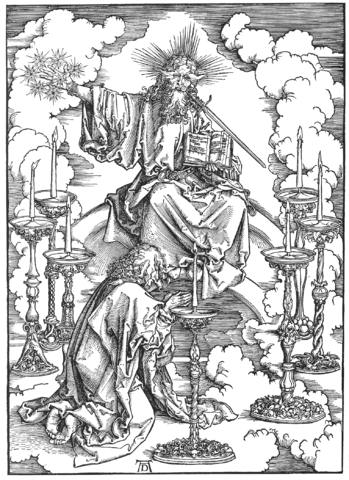

The Gospel in Revelation
Argument, controversy, and dispute always attend to the Book of Revelation. The majority of those who believe they fully understand Revelation tend to understand the images and visions involved in ways which stand quite at variance with the Gospel as presented in the rest of the New Testament. A good number of Christians seek to avoid the Book of Revelation, often feeling more confident about what it does not mean over what Jesus was making known in the vision, and apprehensive about it all because of all the wild theories and doomsday cults who seem to revel in Revelation. One might therefore think it a reasonable conclusion to wonder if the Gospel can be found much in the Book of Revelation, or why one might try to find it there. And yet it is the God behind the Gospel who gave the revelation which belongs to Jesus the Christ, the star of the Gospel, to John (Revelation 1:1). The visions within the Book of Revelation, in fact, are founded upon the life, death, resurrection, ascension, lordship, and imminent return of Jesus of Nazareth, and powerfully portray Him as the Lord and Christ consistent with, and not in a spirit contrary to, the witness of the Gospel.
As the visions within Revelation transitioned into a whole new phase and dimension, John was shown a great sign: a pregnant woman about to give birth (Revelation 12:1-2). A powerful dragon sought to consume the Child as soon as He was born (Revelation 12:3-4). The Child was born, and He would rule the nations with a rod of iron (Revelation 12:5; cf. Psalm 2:8-9). By common confession, the Child born in this vision represents Jesus of Nazareth Himself; the dragon, Satan (Revelation 12:9). In this way, God powerfully attested to Jesus’ life within the visions of Revelation.
One of the first visions John received featured the throne scene in heaven (Revelation 4:1-5:14). God would introduce the central figure in the Book of Revelation in this scene: the “Lion of Judah,” the “root of David” who had “conquered” and was worthy to open the seals on a scroll and make known all which would be presented in Revelation (Revelation 5:5). When John looked to see who this “Lion of Judah” would be, he saw a Lamb as though slain (Revelation 5:6). Throughout the rest of the visions within the Book of Revelation, Jesus, the Lion of Judah and Root of David, would be predominantly presented as this Lamb who had been slain (Revelation 5:8, 12, 13; 6:1, 3, 5, 7, 9, 12, 16; 7:9, 10, 14, 17; 8:1; 12:11; 13:8; 14:1, 4, 10; 15:3; 17:14; 19:7, 9; 21:9, 14, 22, 23, 27; 22:1, 3). In case there had been any confusion, those before the throne praised Jesus the Lamb as worthy to open the scrolls because He had been killed, and He had purchased people from all kinds of tribes and nations with His blood (Revelation 5:9). In this way Jesus’ sacrificial death proved critical and foundational to everything displayed in the visions of the Book of Revelation, for Jesus was primarily presented as the Lamb who suffered and died so all might obtain the forgiveness of sins.
John spoke of Jesus as the “firstborn from the dead” in Revelation 1:5. Likewise, when Jesus first appeared before John as the “one like a Son of Man,” He spoke of Himself as the First and the Last, the One Who Lives, for He had died but now was alive, and now held the keys of Death and Hades (Revelation 1:17-18, 2:8). As we have seen, Jesus was portrayed in Revelation most often as the Lamb who was slain and yet is very much alive. Thus indeed Jesus died, but on the third day He rose from the dead: because of His resurrection, Jesus is now alive again. Jesus’ resurrection may not be the most prominent theme in the Book of Revelation; nevertheless, Revelation does bear witness to Jesus’ resurrection, and His resurrection proved necessary to allow for all which would be made known in Revelation.
In Revelation 12:5, after the Child was born, He was suddenly caught up to God and His throne. This event would catalyze a great conflict which would eventually lead to Satan falling from heaven to earth and all which would be displayed in Revelation 13:1-20:10. By common confession, this event represented Jesus’ ascension, to which Revelation therefore also bears witness.
In Revelation 1:5, John did not only speak of Jesus as the firstborn from the dead, but also as the Ruler over the kings of the earth; He was able to appoint Christians as a kingdom because He reigns as Lord (Revelation 1:6). The Lamb who was slain but is alive did not just sit around in heaven: the Lamb reigned over heaven and earth, and those before His throne declared Him worthy to receive power and might (cf. Revelation 5:12-13). Jesus pronounced all the judgments presented in Revelation as the Lord and Judge of all nations; while the beast raged and presumed himself the greatest power, Jesus strengthened and sustained those who resisted and/or overcame him by suffering even unto death, and Jesus would eventually ride forth on the white horse, judging the beast and all stood in opposition against His rule and purposes (Revelation 6:1-11:19, 13:1-19:21). In so doing, Jesus was not somehow being portrayed in radical differentiation than the Jesus we encounter in the Gospel accounts: Jesus was given all such power because He suffered, died, and was raised again, and such would be the way all who would overcome the world in Jesus would likewise triumph. Furthermore, as Jesus had pronounced judgment on Jerusalem and His fellow Israelites who rejected Him, so judgment was also pronounced against the beast and all those who would continue to reject Jesus and His ways (cf. Matthew 24:1-36, etc.).
The final visions of Revelation featured a judgment scene before the great white throne and then the “new heavens” and the “new earth,” in which the people of God, glorified by God, came down from heaven, described in terms of unimaginable wealth in gold and precious jewels, with God and the Lamb dwelling in their midst forever (Revelation 20:11-22:5). After these visions, Jesus would twice declare how He would be coming soon, which John would affirm as the concluding words of Revelation (Revelation 22:7, 20). In this way Revelation bore witness to our hope and confidence in Jesus’ imminent return.
The Book of Revelation does not prove antithetical to any aspect of the message of Jesus’ life, death, resurrection, ascension, lordship, and imminent return. Quite the contrary; without the Gospel, there would be no revelation of Jesus for God to give to John. Revelation remains saturated with images and descriptions from the prophets of the Hebrew Bible, yet they are often adapted and modified to work according to all God has accomplished in Jesus. In its own way, Revelation provides encouragement to Christians to stand firm in Jesus as Lord and to follow His ways, to serve the Lamb who was slain and overcome His enemies, not with coercion or violence, but with love, charity, and sacrifice. Jesus will have the final victory because He already overcame sin and death through His life, death, resurrection, ascension, and lordship. May we all jointly participate with Jesus in His Kingdom so we might share in the resurrection of His life when He returns. Amen! Come, Lord Jesus!
Ethan R. Longhenry
Leave a Reply