

Third Book of Maccabees (3 Maccabees)
An arrogant Macedonian king; a threatened persecution of Jewish people; righteous prayers; providential deliverance and vindication: the Third Book of Maccabees would seem to fit right in with other stories about the Maccabean/Hasmonean period. And yet the stories told in the Third Book of Maccabees have nothing at all to do with the Maccabean revolt, purporting to describe events which took place a half a century beforehand. What, then, is going on with the Third Book of Maccabees?
The Third Book of Maccabees (3 Maccabees) has been preserved in the Greek Septuagint, and was most likely composed in Koine Greek. It has no identified author; the rhetoric and style of the composition strongly suggest a Jewish man from Alexandria, a decently well-educated speaker of Greek familiar not only with the Hebrew Bible but also some Hebrew and Greek works we deem apocryphal or pseudepigraphal. The Third Book of Maccabees began with stories surrounding Ptolemy IV Philopator’s victory over Antiochus III (“the Great”) at the Battle of Raphia in 217 BCE and events which purportedly took place soon afterward. But suggestions regarding when the Third Book of Maccabees was written vary: many advocate for a date in the early part of the first century BCE in the waning days of Ptolemaic power in Egypt; some advocate for a date toward the end of the first century BCE as the Romans were taking over; and others advocate for a date around 40 CE in the days of Gaius/Caligula Caesar. Regardless, there remains a general agreement the Third Book of Maccabees was composed well after the events it purports to describe, even well after the Maccabean revolt, yet still during the Second Temple Period.
The Third Book of Maccabees can be found online at https://www.biblegateway.com/passage/?search=3%20Maccabees%201&version=CEB and following pages. In 3 Maccabees 1:1-5, Ptolemy IV Philopator’s victory at the Battle of Raphia was described, also featuring how Dositheus, Jewish by birth, foiled a plot to assassinate the king. After the battle, Ptolemy visited Jerusalem; he developed a desire to enter the Most Holy Place, and was strongly discouraged from doing so by the fervent prayers and fanatical willingness to resist by the Jewish people of Jerusalem (3 Maccabees 1:6-29). The author then set forth the prayer of Simon the high priest [Simon (II) bar Onias, possibly also known as Simon the Just, most likely actually high priest in 217 BCE): he prayed for God to remember His choice of Jerusalem and His people Israel, confessed their sins and their plight under their enemies, and asked for deliverance from this potential abomination (3 Maccabees 2:1-20). God would then cause Ptolemy to suffer some kind of paralysis, and thus he was prevented from his design; he would recover but would not repent of his intentions, and all he would design against the Jewish people would take place because of this frustration (3 Maccabees 2:21-26).
According to the Third Book of Maccabees, Ptolemy IV Philopator began executing his designs against the Jewish people by decreeing a special poll tax and branding with symbols of Dionysus upon them, offering exemption for any Jewish person who would be initiated into the Dionysian mysteries: some Jewish people abandoned the customs of their ancestors and complied with Ptolemy, but most found various means to resist (3 Maccabees 2:27-33). Faced with this opposition, Ptolemy grew angry and began to work to have all the Jewish people in Egypt killed; while malicious rumors spread among the people, the Jewish people continued to serve God faithfully and lived as model citizens, gaining some sympathy among many of the people (3 Maccabees 3:1-10). 3 Maccabees 3:11-30 purported to preserve a letter of Ptolemy sent to all his generals and authorities in Egypt, describing the believed perfidy of the Jewish people and his desire for them to be imprisoned and brought to Alexandria for punishment while anyone assisting or harboring them would also suffer greatly. The author would go on to dramatically and graphically describe the Jewish people in various phases of life all rounded up and sent to a hippodrome in Schedia (3 Maccabees 4:1-11). All the Jewish people there were to be registered and then tortured and killed; but the scribes would run out of papyrus and ink to complete the registration on account of the large number of Jewish people in the land, and thus Ptolemy’s designs were frustrated by God (3 Maccabees 4:12-21).
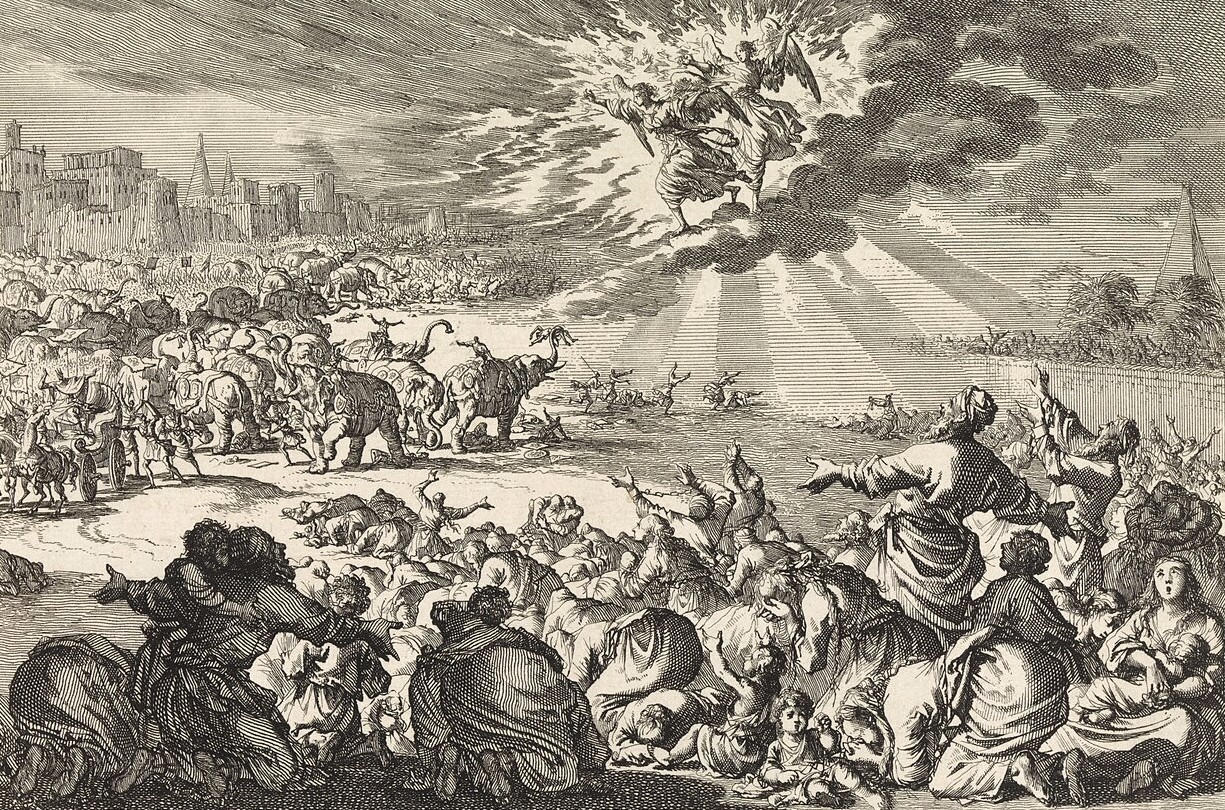
But apparently Ptolemy IV Philopator’s wrath only multiplied: he would command Hermon, the keeper of his elephants, to bring forth the king’s elephants drunk and agitated so they might crush a vast number of the Jewish people (3 Maccabees 5:1-2). But over the next couple of days, God would bring various kinds of influences to bear on Ptolemy who would then command Hermon to desist, only to later turn and again command Hermon to crush the Jewish people; this caused great tumult among not only the Jewish people but also those in the king’s court (3 Maccabees 5:3-51). The author then set forth what he deemed the prayer of one Eleazar, a well-known and respected priest, who prayed for God to remember how He had delivered His people in times past and to display His great power before the people of the nations before them (3 Maccabees 6:1-15). As the prayer finished, the king and his retinue entered the hippodrome, and soon after God sent two angels to appear to and resist the people of the nations (3 Maccabees 6:16-19). The elephants then turned away from the Jewish people and began crushing the king’s army and forces; the whole scene led the king to repent of his insolence and behavior (3 Maccabees 6:20-23). After censuring and condemning those who sought the destruction of the Jewish people, the king released the Jewish people from their imprisonment and made command for them to be provisioned to enjoy a great feast, leading to great joy and celebration among the Jewish people (3 Maccabees 6:24-41). 3 Maccabees 7:1-9 would represent another letter of Ptolemy IV Philopator to his generals and authorities, this time condemning those who had advanced designs against the Jewish people, vindicating and acquitting the Jewish people of all charges, and warning against any impieties against the God of Israel. The Jewish people were then given the ability to gain vengeance over some of their enemies and were able to return to their homes in joy and honor among the people, all thanks to the providence and deliverance of God (3 Maccabees 7:10-23).
By common confession, the Third Book of Maccabees is reckoned among the apocryphal and deuterocanonical works. It was preserved as part of the Greek Septuagint, but was not translated into Latin as part of the Latin Vulgate; because of this one will not find the Third Book of Maccabees within the Roman Catholic Apocrypha, although it can be found in the apocrypha of the Orthodox families of churches and in many Protestant forms of the apocrypha. Jewish authorities have paid the Third Book of Maccabees little heed throughout the ages; Roman Catholics and Protestants agree it is neither canonical nor inspired; the Orthodox do tend to consider it canonical and may claim inspiration for it, but even among them the Third Book of Maccabees has not left much of an impact.
How much confidence can we have in the historical veracity of the stories found in the Third Book of Maccabees? Other historical witnesses testify to Ptolemy IV Philopator as king of Egypt and Judah in 217 BCE and the victor over Antiochus III (“the Great”) of Seleucia at the Battle of Raphia (e.g., Polybius, Histories 28; 3 Maccabees 1:1-5). The apocryphal Book of Sirach bore witness to Simon bar Onias as high priest of Israel around the time of 217 BCE (Sirach 50:1-7; 3 Maccabees 2:1). We have no other author bearing witness to anything like what was recorded in the Third Book of Maccabees during the time of Ptolemy IV Philopator (ca. 221-204 BCE). There are descriptions of events which sound quite similar to what was presented in the Third Book of Maccabees, yet they are associated with different rulers at different times. Josephus spoke of how Ptolemy VIII Physcon tried to have many Jewish people crushed by drunken elephants in Alexandria in retaliation for their support of Cleopatra II in Against Apion 2, but this would have taken place around 75 or more years after the days of Ptolemy IV Philopator (and even then, no one else bore witness to this event; cf. 3 Maccabees 5:1-6:23). We have historical witness for the “abomination which makes desolate” regarding the Most Holy Place in the Temple featuring both Antiochus IV Epiphanes in 167 BCE and the Roman general Pompey in 63 BCE (Josephus, Antiquities of the Jews 12, 14), but no such witness regarding Ptolemy IV Philopator has been preserved (cf. 3 Maccabees 1:8-2:24). Granted, absence of evidence is not always evidence of absence, but we have every reason to expect Josephus or someone else to mention something about these kinds of difficulties for the Jewish people in the days of Ptolemy IV Philopator if they had well and truly occurred.
Perhaps one can squint and make out a possible historical kernel of truth in which Ptolemy IV Philopator might have engaged in some level of persecution of Jewish people because they would not go along with some attempt he might have made to encourage them to Hellenize to some degree or another. Yet even if this were the case, the stories as presented in the Third Book of Maccabees prove heavily dramatized, more likely inspired from Daniel, Esther, 2 Maccabees, the Book of Judith, as well as Greek romances.
Therefore, the Third Book of Maccabees is certainly apocryphal; the author is unknown, likely writing long after the events he purported to preserve, and during a time when no prophet had arisen among the Israelites to present inspired witness. While the author rooted his stories in the Third Book of Maccabees relatively accurately according to its historical context, naming appropriate Ptolemaic and Seleucid kings and the Jewish high priest, whatever historical evidence might exist for the substance of the stories is associated with other rulers at other times. Flavius Josephus clearly had no confidence in the Third Book of Maccabees as a historical source for the days of Ptolemy IV Philopator, and therefore neither should we.
So what should we make of the Third Book of Maccabees? No Maccabees are involved in the story; it might have been named the Ptolemaica in antiquity, which would prove a much more accurate name. Nevertheless, we can understand why these stories would get associated with the name of the Maccabees: its author was no fan of Jewish people abandoning the customs of their ancestors to become more like the Greeks, whether from their own desire or on account of imperial pressure, and he wanted to celebrate his fellow Jewish people who would resist persecution at the hands of their oppressors. Yet he did so through the ironic means of a Greek-style romance, imagining a long dead Ptolemaic king as a combination of all kinds of very real persecuting Macedonian (and possibly Roman) rulers attempting to impose a kind of conformist Hellenism on the peculiar, and easily marginalized, Jewish people. In this story, faithful Jewish people pray to God and despite all the odds, God providentially protects and ultimately vindicates His people. The ruler learned his lesson, and the Jewish people can prosper. We can understand why a Jewish man of Alexandria in Egypt would want to encourage that kind of perspective for his fellow Jewish people in Egypt and beyond. And we can understand why the Third Book of Maccabees has not left a major impact on either the Jewish or Christian faith; nevertheless, in it we can find witness of the kind of faith which Jewish people maintained in the days before or during the life of Jesus of Nazareth, and also why the Jewish people of His time would be earnestly looking for God to deliver and vindicate them in the face of pagan oppressors. We do well to put our trust in the supreme God as made known in Christ through the Spirit, and obtain deliverance in Him from sin and death!
Ethan R. Longhenry
Works Consulted
3 Maccabees (accessed 2026/11/25).

Leave a Reply