


The Letter of the Church of God in Rome to the Church of God in Corinth (Clement to the Corinthians; 1 Clement)
Dissension had arisen among the Christians in Corinth again. Paul and Peter were gone; the time of the apostles was passing away. The elders of the church in Rome determined to write to encourage the church in Corinth in general regarding their shared faith, and particularly in regard to the matters of dispute reported to them.
This letter from the church in Rome to the church in Corinth was composed anonymously. It was most likely written by one hand; tradition has associated it with Clement, recognized as a presbyter, or elder, of the church in Rome (cf. Irenaeus, Against Heresies 3.3.3). Clement would become known as Clement of Rome: later Christians would assert he was a co-laborer of Paul and appointed to the eldership by Peter himself, although many of them associated him with the Clement mentioned in Philippians 4:3, who was most likely a similarly named yet different person (Tertullian, Prescription Against Heretics; Eusebius of Caesarea, Church History 3.4.10). Later traditions also considered Clement of Rome a martyr, suggesting he was executed by Trajan around 100 by being tied to an anchor and drowned (Tyrannius Rufinus, Martyrdom of Clement). The letter from the church in Rome to the church in Corinth seems to be the only agreed upon writing we have from Clement of Rome; there is a second letter purported to have been written by Clement (2 Clement), but most believe it to be later and pseudepigraphal.
In antiquity, the letter from the church in Rome to the church in Corinth was known as “Clement to the Corinthians”; today we generally speak of it as the First Letter of Clement, or 1 Clement. Scholars disagree among themselves regarding the dating of 1 Clement, with some arguing for a date as early as around 70 and some for a date as late as 140. A date around 95 would make the best sense of the internal evidence: 1 Clement was written as if the passing of Paul and Peter was in the past but still known within living memory, and the “sudden and repeated calamities and reverses” the church in Rome was experiencing would be consistent with local persecution by Diocletian (1 Clement 1:1).
1 Clement can be read online through https://www.earlychristianwritings.com/1clement.html. After greeting the church in Corinth, Clement praised the Corinthian Christians for the well-deserved reputation of their faith in order to more strongly rebuke them for recent events in which some of the elders, or presbyters, had been deposed (1 Clement 1:1-3:4). Clement then listed out some examples of jealousy and its effects from characters in the Scriptures and from Greek and Roman mythology; in contrast, he also extolled the examples of Peter and Paul, and in so doing provided some of the earliest testimony to their martyrdoms (1 Clement 4:1-6:4). Clement urged the Corinthian Christians to repent and presented many examples of repentance from Scripture (1 Clement 7:1-8:6).
Clement continued to encourage the Corinthian Christians toward faithfulness and hospitality, appealing to examples like Enoch, Abraham, Lot, and Rahab (1 Clement 9:1-12:8). Clement warned against following after those who set themselves up as leaders in their jealousy but praised pursuing peace and especially humility, appealing to many examples, above all that of Christ, to encourage humility (1 Clement 13:1-19:3). After describing how the universe was subject to God’s rules of order and peace, Clement exhorted the Corinthian Christians to likewise obey God and honor the appropriate leaders over them, and confirmed this message with quotations from Scripture (1 Clement 20:1-22:8).
Clement turned to exhort regarding confidence in the Lord’s return and the resurrection, appealing to examples in nature, the (legendary) phoenix, and the witness of Scripture (1 Clement 23:1-26:3). In light of the hope of the resurrection, Clement would spend some time encouraging the Corinthian Christians to persevere in faithfulness and righteousness, drawing near to God, avoiding wickedness, and obtaining God’s blessings in the process (1 Clement 27:1-30:8). Clement considered how the patriarchs were blessed, and in so doing affirmed how Christians are justified by faith and not works (as Paul taught), but then also the importance of serving God faithfully (as Paul and James encouraged; 1 Clement 31:1-35:12). Clement affirmed how all blessings came through Christ whom Clement likened unto a commander or general; thus, all Christians should be subject to Him and to one another, and for everyone in their position to behave appropriately toward one another (1 Clement 36:1-39:9).
Clement then encouraged the Corinthian Christians to maintain the order in the church they had received, using the order of the sacrificial system of the Jerusalem Temple as a metaphor (1 Clement 40:1-41:4). The Apostles received the Gospel from Jesus who was sent by God; the Apostles then appointed those whom they proved by the Spirit to be bishops and deacons in the churches (1 Clement 42:1-5). Clement then appealed to Israel’s aspersions cast against Aaron and its results in Numbers 16:1-17:13 as an example (1 Clement 43:1-6). Clement then suggested the Apostles in Christ knew there would be strife over the name and office of the bishop, and they therefore made provision to have bishops appointed in succession, humble servants with good reputations; Clement then declared former faithful presbyters as blessed, and then excoriated the Corinthian Christians for displacing presbyters who were ministering blamelessly (1 Clement 44:1-5).
Clement chastised the Corinthians for their love of contention, and encouraged them instead to prove zealous about salvation and the message of Scripture, appealing to many examples from its pages, so they might resist strife and division and strive for unity in the faith (1 Clement 45:1-46:9). Clement then made explicit appeal to Paul’s First Letter to the Corinthians and the party spirit condemned therein (1 Clement 47:1-3; cf. 1 Corinthians 1:10-4:21). He considered it shameful how the “steadfast and ancient” Corinthian church would cast out its presbyters for the sake of one or two members; the report of this had gone beyond the church to the pagans around as well, causing even greater shame, and they should repent before Jesus and be reconciled to their presbyters and to their fellow Christians in Rome. and share in love, which Clement further commended from the witness of Scripture and in the world (1 Clement 47:4-55:6).
Clement also encouraged the Corinthian Christians to pray for those in sin so they would yield to the will of God, and for all who receive it to accept chastisement (1 Clement 56:1-16). He exhorted those who led the coup against the presbyters to submit to those presbyters and receive chastisement unto repentance, and manifest humility (1 Clement 57:1-7). Clement then exhorted all of the Corinthian Christians to receive the counsel from Rome; those who would prove disobedient would endanger themselves, but the Roman Christians would be guiltless (1 Clement 58:1-59:2). Clement then set forth an extended prayer to God in Christ to guard His elect, for His people to better know Him, to help His people, to praise His works, to forgive His people their transgression, and for the welfare of the rulers and for Christians to continue to submit to them while not resisting the Lord’s will in anything (1 Clement 59:2-61:3). Clement concluded the letter by reiterating his confidence in the Corinthian Christians, encouraging them toward faithfulness to God in Christ, commending those sent to bear witness to them and exhort them, praying for all the faithful in Christ to have the attributes necessary to prove well pleasing to God, encouraging them to send their witnesses back soon, and a doxological epistolary conclusion (1 Clement 62:1-65:2).
1 Clement was well and highly regarded among early Christians. It was reported to have been read in the Corinthian church on frequent occasions (and by which, we presume, its message was well received), and was also read frequently in other churches. 1 Clement has been found as part of the compilation of ancient Bible codices, and may have been continually highly regarded in some places well into the medieval period.
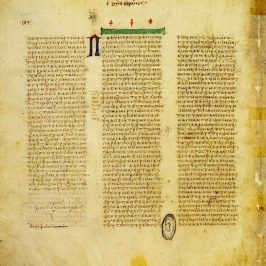
While knowledge regarding 1 Clement was never lost, the full manuscript of the letter was lost to history (at least in the West) some point during the medieval period. A portion of 1 Clement was found in 1628 in a manuscript of a Greek Bible given to King Charles I of England; the first full copy of 1 Clement was discovered in an 11th century Greek codex in 1873. Other copies of the letter in its Latin and Syriac translations would be rediscovered through various means in the nineteenth century.
What should we make of 1 Clement? While some early Christians may have regarded the letter as inspired of God, its author seemed content to provide exhortation rooted in the Scriptures themselves and in the witness of the Apostles. We best understand 1 Clement as providing critical, important evidence regarding the situation and organization of local churches in the immediate wake of the departure of the Apostles and before the development of the monarchical episcopate system of the second century and beyond.
Later Christians would presume Clement was the bishop of Rome writing to the church in Corinth, but the letter itself does not suggest he understood himself as such. He did not even identify himself explicitly; he was content for the letter to be representative of the Roman church to the Corinthian church. Clement, like Paul and Peter, seems to use “elder/presbyter” and “bishop” interchangeably, as can be seen in 1 Clement 42:1-5, 44:1-5 (cf. Acts 20:17-38, 1 Peter 5:1-4). It is worth noting that the church in Corinth by this point had presbyters (or at least formerly did, considering the reason for the letter), a situation which did not seem to be the case based on how Paul wrote his two letters to them ca. 54-56; and note Clement’s use of the plural, and not the singular, throughout.
1 Clement bore witness to the situation in the Corinthian church after the days of the Apostles. Clement expected the Corinthian Christians to be able to remember the things Paul had written directly and explicitly to them, and considered the church in Corinth as ancient and venerable (1 Clement 47:1-5). Yet, based on what was written, it would seem a couple of agitators had led to the dismissal and humiliation of at least some of the presbyters/elders/bishops of the church (cf. 1 Clement 47:5ff). The whole letter was Clement’s rebuke of this behavior; since the letter was preserved throughout antiquity, we have good reason to believe the Corinthian church accepted the rebuke and restored those presbyters/elders.
1 Clement also bore witness to how situations like this might be managed. At no point did Clement presume he, or the Roman church, exerted any kind of special authority over the Corinthian church; instead, he exhorted them to faithful conduct and made appeals on the basis of the Scriptures and the witness and example of the Apostles. He did threaten to consider them as no longer faithful to the Lord if they did not repent of their behavior in 1 Clement 58:1-59:2. We do well to note how Clement did not presume to have authority based upon his office personally or on behalf of the whole church in Rome; instead, the Roman church was writing to the Corinthian church to exhort them regarding their common faith in Jesus and to rebuke some unfaithful behaviors.
Clement did bear witness to a form of succession after the Apostles, but he did not testify to anything remotely resembling the “apostolic succession” claimed by the Roman Catholic or similar organizations. Instead, Clement bore witness to the same pattern we find in the New Testament: Jesus appointed the Apostles to bear witness to the Gospel and to distribute the message throughout the world, and they would appoint, by the prompting of the Spirit and the testimony regarding their conduct, bishops/presbyters/elders and deacons for the local churches (1 Clement 42:1-5; cf. Acts 14:23, 1 Timothy 3:1-12, Titus 1:5-9).
Clement very much testified to the importance and power of the Scriptures; a good portion of the letter represents quotations of various Scriptures. Most of what he calls Scripture comes from the Hebrew Bible; he proved more than willing to make reference to stories from apocryphal and pseudepigraphal works along with well-known Greek mythological and legendary characters. But Clement was not ignorant of the works which we would come to call the New Testament; his letter explicitly made reference to 1 Corinthians, used phrases from Hebrews, alluded to Romans, Galatians, Ephesians, Philippians, 1 Timothy, and Titus, and seemed conversant with at least 1 and 2 Thessalonians and Philemon.
Clement provided a lot of exhortation regarding faithful Christian living. He would commend faith in righteousness rooted in the life of Christ and informed by the examples throughout the Scriptures. His exhortations prove quite consistent with the exhortations the Apostles would provide in their written correspondence. His prayers asked for the same kinds of things the Apostles would ask for in prayer in their correspondence. Clement robustly affirmed the hope of the resurrection and would chide anyone who would discount or dismiss it.
1 Clement, therefore, provides Christians with a lot of encouragement regarding our shared faith in Jesus. Clement bore witness to the time of transition from the time of the Apostles to the perpetuation and growth of local churches shepherded by bishops/elders/presbyters and served by deacons, making appeal to the witness of the Scriptures in the Hebrew Bible and the memories and examples of Jesus and the Apostles, very much informed by the preserved writings of the Apostles and their associates in what would become the New Testament. May we share in that same faith in Jesus so we might also share in the resurrection of life!
Ethan R. Longhenry
Works Consulted
First Epistle of Clement (accessed 2026/05/27)



Leave a Reply