Baruch | The Voice 15.35: August 31, 2025

posted in: The Voice | 0

The Voice

The Book of Baruch (1 Baruch)

The Book of Baruch, sometimes called 1 Baruch, can be found in the Greek Septuagint and the Old Testament Apocrypha, but is not found in the Hebrew Bible or in most versions of the Old Testament. Who is Baruch? What is the Book of Baruch all about? How should Christians view the Book of Baruch?

The Book of Baruch claimed to be written by Baruch ben Neriah (Baruch 1:1). Baruch ben Neriah was a scribe associated with the prophet Jeremiah ben Hilkiah of Anathoth: Baruch would often write down the prophecies of Jeremiah which Jeremiah would dictate to him, and when Jeremiah was not allowed to enter the Temple precinct, he commissioned Baruch to go on his behalf and read out the word of YHWH which was given to Jeremiah (cf. Jeremiah 32:12-13, 16, 36:1-32, 43:3, 6). Jeremiah 45:1-5 represented a word of YHWH through Jeremiah specifically to Baruch: Baruch had despaired in his suffering and groaning; YHWH did not present the situation in glowing terms, since He was bringing disaster on the world, but promised Baruch he would escape with his life wherever he might go. Baruch ben Neriah, therefore, was a real person, living at the beginning of the sixth century BCE, a witness to the destruction of Jerusalem, and ultimately an exile in Egypt with Jeremiah (cf. Jeremiah 43:6). Baruch was indeed a Biblical character of some importance: not only was he an associate of Jeremiah, but Baruch was most likely the one responsible for the actual composition and writing of the Book of Jeremiah, and received a specific blessing from YHWH Himself.

The Book of Baruch was collected as part of the Greek Septuagint and has been fully preserved in Codices Alexandrinus and Vaticanus (among others), although not in Codex Sinaiticus. Arabic, Armenian, Bohairic, Coptic, Ethiopic, Latin, and Syriac versions all present indications they are direct translations from the Greek text. Origen betrayed no understanding of any Hebrew original in the Hexapla of the Book of Baruch, and Jerome said there were no existing copies in Hebrew in his own day; nevertheless, some aspects of the text, especially in Baruch 1:1-3:4, present Semitisms and perhaps even mistranslations of an original Aramaic or Hebrew, so a Hebrew original cannot be entirely ruled out.

The Book of Baruch can be found in almost all versions of the Apocrypha and also online here. The Book of Baruch began with an editorial comment, identifying the author as Baruch (with a much more expanded genealogy) and suggesting material was read out before Jeconiah and the exiled people of Judah in Babylon “in the fifth year, on the seventh day of the month,” when the Chaldeans destroyed Jerusalem (Baruch 1:1-4; cf. Jeremiah 36:1-32, Ezekiel 1:2?). After they wept, fasted, and prayed, the exiles of Judah then sent a collection with a priest, Jehoiakim ben Hilkiah, to be sent to Jerusalem, so offerings could be made before God there, and for the welfare of Nebuchadnezzar and his son Belshazzar, and for themselves, and for Baruch to read the scroll as a form of confession and contrition in the Temple; at the same time Baruch was collecting the silver vessels taken from the Temple to return them to Jerusalem (Baruch 1:5-14).

The confession which was supposed to be spoken in the Temple was set forth in Baruch 1:15-3:8. Baruch 1:15-2:10 featured a confession of sin, lamenting the disobedience of Israel since the days in the Wilderness, the rejection of the messages of the prophets, recognition of the suffering of the consequences for disobedience laid out in the Law of Moses, and recognition of continued distress, exile, and suffering because of the sins of the people presently. Baruch 2:11-3:8 turned toward an appeal to God for His anger to turn away from them for the sake of His Name, begging for God’s mercy, aware of how they did not listen to what the prophets told them and thus have suffered devastation and exile, and imploring God to remember promises of restoration given through Moses.

After this extended prayer, and without any real transition of any sort, the Book of Baruch presented an exhortation toward obtaining wisdom in Baruch 3:9-4:4. Israel was exhorted to reflect well on her past and obtain wisdom in the process, to turn to God and to know His ways (Baruch 3:9-15). Such wisdom was not found among the Canaanites, Edomites, or Arabs; a person could not go and search for it and find it in the heavens or elsewhere; only God knows the ways of knowledge and wisdom, and would give them to Israel, found in the commandments of Torah; therefore Israel should not give God’s glory to foreigners but be happy they can know what pleases God (Baruch 3:16-4:4).

The Book of Baruch continued, again without any noted transition, into what has been deemed the “Consolation of Baruch” in Baruch 4:5-5:9. In what seems to be a pastiche of all kinds of prophecies regarding Jerusalem and Zion, the author exhorted the people of Israel to take courage, understanding how the destruction of Jerusalem and their exile was the result of angering God on account of disobedience in idolatry; Zion grieved because of it; their neighbors were invited to see and learn from the disobedience of the Israelites; and yet Zion maintained the confidence God would restore His people, and God would comfort her and make sure she was rebuilt; Jerusalem would again exult and rejoice and would forever enjoy the glory of God when He would lead Israel back again.

In many modern translations of the Apocrypha, including the Revised Standard Version and New Revised Standard Version, the Letter of Jeremiah is presented as the final chapter of the Book of Baruch (as Baruch 6:1-73). This follows the convention set forth in the Latin Vulgate. In the Greek Septuagint, however, the Letter of Jeremiah was presented as an independent work. Since the Letter of Jeremiah would claim to have been written by Jeremiah, not Baruch, and by common confession the Letter of Jeremiah reflects an independent composition, we will not consider it as part of the Book of Baruch.

What should we make of the Book of Baruch? We find no attestation of it in the Dead Sea Scrolls or in rabbinic literature. Early Christians have a high regard for the Book of Baruch in evidence from the late second century onward. The Book of Baruch and the Letter of Jeremiah were often found right after Jeremiah and before Lamentations in the Greek Septuagint. We should remember the Greek Septuagint edition of Jeremiah is one-seventh shorter than the edition in the Masoretic Text, and the text is ordered differently, with Jeremiah’s message of blessing Baruch coming at the end of the Greek version of Jeremiah (Jeremiah 51:31-35 LXX). The editorial comment of Baruch 1:1-4, in fact, is more naturally understood to refer to reading aloud that which came before rather than that which would follow afterward: therefore, early Christians understood the Book of Baruch as simply carrying on the narrative begun in Jeremiah with Baruch reading the Book of Jeremiah before exiled Israelites in Babylon. To this end, Augustine thus argued for Jeremiah, the Book of Baruch, the Letter of Jeremiah, and Lamentations as all the words of Jeremiah written down by Baruch. Such is why the Book of Baruch was believed to be canonical according to many early Christians, and why it was more explicitly attested in the East while more likely wrapped in with Jeremiah in the West.

Nevertheless, the Book of Baruch proves very difficult to accept as a sixth century BCE composition. The editorial framework of Baruch 1:1-14 stands at variance with narratives presented within Jeremiah and with recorded history. First of all, the framing itself seems rather confused: in Baruch 1:1, it seems to borrow “the fifth year” from the fifth year of Jehoiachin’s exile from Ezekiel 1:2, which would be 593 BCE, but the Chaldeans would only take Jerusalem and burn it with fire in 586 BCE. A pre-destruction date might make better sense of the exiles sending silver with a priest in order to make offerings at the Temple; offerings might still have been offered after the destruction according to Jeremiah 41:5, but the whole scene remains difficult to imagine in its context, since we have no evidence the Judahite exiles were in any mood to pray for the welfare of Nebuchadnezzar immediately before or in the immediate wake of the destruction of Jerusalem, and plenty of evidence in Jeremiah and Ezekiel to the contrary (cf. Jeremiah 29:1-32, Ezekiel 37:11). Speaking of Belshazzar as Nebuchadnezzar’s “son” and expecting prayers for him in the 580s would prove quite historically anachronistic and very much influenced by Daniel 5:2. Yet, above all, the Book of Jeremiah consistently bears witness of Baruch staying with Jeremiah in Jerusalem and ultimately ending up exiled with Jeremiah in Egypt (cf. Jeremiah 32:12-13, 16, 36:1-32, 43:3, 6); Baruch is never in Babylon or among the exiles in Babylon, contrary to Baruch 1:1-14. The editorial composition of Baruch 1:1-14 is far better understood as a far later composition of the Second Temple Period providing either some kind of independent introduction to the material which would follow, or perhaps intentionally written as a bridge connecting the following material with the Book of Jeremiah as presented in the Greek Septuagint.

But what of the material in the rest of the Book of Baruch? The confession of sin in Baruch 1:15-3:8 and the “Consolation of Baruch” in Baruch 4:5-5:9 do sound very similar to prayers of confession and contrition in Daniel, Ezra, and Nehemiah and the prophetic messages regarding Jerusalem and Zion in Isaiah and Jeremiah, respectively. The exhortation regarding wisdom in Baruch 3:9-4:4, however, has no parallel in any of the books of the prophets in the Hebrew Bible. While one might want to make connections with the Book of Proverbs and the wisdom literature tradition, the stronger point of connection would be the Book of Sirach.

Based upon all these considerations and factors, it proves far more challenging to suggest the Book of Baruch as part of the Book of Jeremiah or an additional composition of Baruch in the sixth century BCE, and makes far more sense to understand the Book of Baruch as a pseudepigraphal, apocryphal work of exhortation, quite likely written around the second century BCE, perhaps in the wake of Antiochus IV Epiphanes’ defilement of the Second Temple and its eventual cleansing by the Maccabees.

Therefore, the Book of Baruch was most likely not written by Baruch ben Neriah. It should not be recognized as inspired literature or therefore part of the canon of the Old Testament. We should not seek to establish any principle of dogma, faith, or practice based on anything written in the Book of Baruch.

But just because the Book of Baruch was not written by Baruch and is not Scripture does not mean Christians cannot benefit from it. Instead, Christians can take encouragement and gain some insight from the confession of sin, exhortation toward wisdom, and hope in consolation presented in the Book of Baruch: not as the inspired words of Jeremiah’s scribe, but as examples of the devotion, faith, and piety of some Jewish people of the Second Temple Period a few generations before the coming of the Lord Jesus Christ. Christians can always benefit from deeper consideration of prayers of confession and contrition; there are many aspects of Baruch 1:15-3:8 which we could well appropriate in our own lives in prayer. The wisdom presented in Baruch 3:9-4:4 can instruct us as well to seek wisdom and knowledge in God and how people have failed in any attempt to create their own substitute. We can also take comfort and assurance in how God is working to restore Jerusalem in His work through the life, death, resurrection, ascension, lordship, and imminent return of the Lord Jesus Christ, and perceive the true fulfillment of the hope of restoration which infused the consolation of Baruch 4:5-5:9.

The Book of Baruch might seek to project itself into the context of Israel in exile in the sixth century BCE, but most likely reflects the situation of Israel in its own kind of exile and challenging predicament in the second century BCE. While Christians should not believe Baruch ben Neriah wrote the Book of Baruch, and they should not reckon it as an inspired, canonical part of the Scriptures, Christians do well to read the Book of Baruch and appreciate it as a piece of devotional literature from the Second Temple Period. May we find appropriate profit in the Book of Baruch, but in all things find knowledge and wisdom and the fulfillment of the hope of restoration in Israel in God in Christ through the Spirit!

Ethan R. Longhenry

Works Consulted

The Book of Baruch (accessed 2025/25/08).

Psalm 2 | The Voice 15.34: August 24, 2025

posted in: The Voice | 0

The Voice

Psalm 2

Psalm 2:1-12, ASV translation, as prose:

Why do the nations rage, and the peoples meditate a vain thing?
The kings of the earth set themselves, and the rulers take counsel together, against YHWH, and against his anointed, saying, “Let us break their bonds asunder, and cast away their cords from us.”
He that sitteth in the heavens will laugh: the Lord will have them in derision. Then will he speak unto them in his wrath, and vex them in his sore displeasure: yet I have set my king upon my holy hill of Zion.
I will tell of the decree: YHWH said unto me, “Thou art my son; this day have I begotten thee. Ask of me, and I will give thee the nations for thine inheritance, and the uttermost parts of the earth for thy possession. Thou shalt break them with a rod of iron; thou shalt dash them in pieces like a potter’s vessel.”
Now therefore be wise, O ye kings: be instructed, ye judges of the earth. Serve YHWH with fear, and rejoice with trembling. Kiss the son, lest he be angry, and ye perish in the way, for his wrath will soon be kindled. Blessed are all they that take refuge in him.

Psalm 2:1-12 ASV according to Hebrew parallelism (as marked in BHS):

Why do the nations rage / and the peoples meditate a vain thing?
The kings of the earth set themselves / and the rulers take counsel together
Against YHWH / and against his anointed,
“Let us break their bonds asunder / and cast away their cords from us.”
He that sitteth in the heavens will laugh / the Lord will have them in derision.
Then will he speak unto them in his wrath / and vex them in his sore displeasure
Yet I have set my king / upon my holy hill of Zion.
I will tell of the decree: YHWH
Said unto me, “Thou art my son / this day have I begotten thee.
Ask of me / and I will give thee the nations for thine inheritance / and the uttermost parts of the earth for thy possession.
Thou shalt break them with a rod of iron / thou shalt dash them in pieces like a potter’s vessel.”
Now therefore be wise, O ye kings / be instructed, ye judges of the earth.
Serve YHWH with fear / and rejoice with trembling / Kiss the son,
Lest he be angry and ye perish in the way / for his wrath will soon be kindled.
Blessed are all they that take refuge in him.

Psalm 2 in the Scottish Metrical Psalter of 1650:

1 Why rage the heathen? and vain things
why do the people mind?
2 Kings of the earth do set themselves,
and princes are combined,

To plot against the Lord, and his
Anointed, saying thus,
3 Let us asunder break their bands,
and cast their cords from us.

4 He that in heaven sits shall laugh;
the Lord shall scorn them all.
5 Then shall he speak to them in wrath,
in rage he vex them shall.

6 Yet, notwithstanding, I have him
to be my King appointed;
And over Zion, my holy hill,
I have him King anointed.

7 The sure decree I will declare:
The Lord hath said to me,
Thou art mine only Son; this day
I have begotten thee.

8 Ask of me, and for heritage
the heathen I’ll make thine;
And, for possession, I to thee
will give earth’s utmost line.

9 Thou shalt, as with a weighty rod
of iron, break them all;
And, as a potter’s sherd, thou shalt
them dash in pieces small.

10 Now therefore, kings, be wise; be taught,
ye judges of the earth:
11 Serve God in fear, and see that ye
join trembling with your mirth.

12 Kiss ye the Son, lest in his ire
ye perish from the way,
If once his wrath begin to burn:
blessed all that on him stay.

Psalm 2 as Poetry

Psalm 2 features a chiastic structure of A B B’ A’ perhaps as a “four act play” or ritual of sorts (Psalm 2:1-3 A, Psalm 2:4-6 B, Psalm 2:7-9 B’, Psalm 2:10-12 A’). The versets display classic Hebrew parallel features, often emphasizing and intensifying the message.

Other aspects of the poetry reinforce associations and connections between Psalm 1 and Psalm 2. Psalm 1:1 begins with a beatitude; Psalm 2:12 ends with one, an inclusio for Psalms 1-2 as an introductory unit. The Hebrew root hagah is found in both Psalm 1:2 (“meditate”) and Psalm 2:1 (sometimes translated “meditate,” also translated “plot”). Many similar lexical associations can be found between the two psalms.

Psalm 2 in Context and Canon

Psalm 2 has no superscription just like Psalm 1; many in antiquity reckoned Psalms 1 and 2 to be a composite unity (cf. certain manuscripts of Acts 13:33 which read “first” for “second”), and even those who recognized them as distinct psalms understood that they served as a dual introduction to the whole Psalter.

The “wicked” of Psalm 1 morph into the nations and peoples who rage and plot against YHWH in Psalm 2; the “righteous” of Psalm 1 is embodied in YHWH’s Anointed One in Psalm 2, the King who will receive power and authority.

If one looks at Books 1 through 3 of the Psalter as “the king in prayer,” Psalm 2 proves a most fitting introduction to this collection. Psalm 2 is certainly a royal psalm, a coronation, part of either an enthronement ceremony or perhaps a covenant renewal ceremony (cf. 2 Kings 11:12).

The history of Israel is full of examples of the danger of instability that marked regnal transitions. When Ahab king of Israel died and Ahaziah took his throne Moab revolted (2 Kings 1:1); in the days of Joram king of Judah Edom and Libnah rebelled (2 Kings 8:22). Kings would frequently need to make military excursions soon after they ascended to the throne so as to continue to project strength and keep vassal kingdoms under submission.

Psalm 2 is composed to this end. The Psalter is aware of the plots and machinations of the nations to rebel against the authority of the Davidic king; in so doing they plot against YHWH as well (Psalm 2:1-3). YHWH sees this from above; He laughs at them and holds them in derision, and in His (burning) anger He will speak and vex them (Psalm 2:4-5). What frustrates the nations? YHWH has set His king on the hill of Zion in Jerusalem (Psalm 2:6). The Davidic king is an authority legitimated by YHWH and is to accomplish YHWH’s purposes (associated with the “righteous” of Psalm 1).

“The decree” is then given; in the ancient Near Eastern world almost every culture had some sort of recognition of adoption of the king as the son of the relevant deity. The Psalter speaks in similar terms: “Thou art my son; this day have I begotten thee” (Psalm 2:7). As a result the Davidic king is invited to ask of YHWH to receive power and dominion over the nations and He will provide (Psalm 2:8-9). Perhaps the Davidic king would use a royal scepter or mace to break a pot as a symbolic gesture to declare his power over the vassal nations in the midst of the declaration of Psalm 2:9.

A taunt or exhortation to the nations follow: they ought to be wise, serve YHWH, and indicate their submission to the rightful Davidic king lest he get angry with them (Psalm 2:10-11). There may be some textual confusion surrounding “kiss” in Psalm 2:10 yet the idea is clear enough: the delegate of the nation(s) ought to provide the proper gesture of subjugation and humiliation before the Davidic king. We should not be surprised to see an expectation for other nations to serve YHWH; we must remember that the standard practice of the ancient Near Eastern world was to respect the gods of other nations and especially give them their due when their people were ascendant. That standard practice proved to be exactly the problem for Israel: the Israelites respected the gods of the other nations and did not serve YHWH exclusively (cf. 2 Kings 17, etc.)!

The point of Psalm 2 is found at the very end: blessings come to those who serve YHWH and His anointed, the Davidic king, and take refuge in him (Psalm 2:12). Problems come to those who would dare to revolt and rebel, thinking the death of one king and the accession of the next to be an indicator of weakness.

The strong association between YHWH and the anointed Davidic king in the face of the nations who would seek to break away from Judahite vassalage provides strong evidence that Psalm 2 belongs originally to the First Temple period. It certainly sounds like a psalm that would be used in an enthronement ceremony declaring the strength of the Davidic monarchy; whether it was used only at the accession of a new king or annually or at certain “jubilee” points, or whether the ceremony would take place at the Temple precinct or in front of the palace cannot be definitively ascertained.

Psalm 1 expressed the two ways, that of the righteous and that of the wicked; Psalm 2 places that in the context of the monarchy. The nations often plot wickedly; YHWH has established the Davidic king and his kingdom based in Jerusalem as the bastion for the righteous and will prosper His people. Psalm 1 provides a framework for the individual to find liturgical value in the Psalms while seeking to practice Torah as an ethic in life; Psalm 2 provides the framework for the nation of Israel to understand how YHWH will triumph over the nations hostile to Israel through His anointed Davidic king. Psalms give voice to the individual to make his complaint before YHWH, but Psalms also give voice to the nation of God’s people to give voice to their frustrations about their plight in light of current events. Psalms 1 and 2 set the tone for the rest of the Psalter: follow YHWH’s torah, remain righteous; the enemies and the wicked will plot, but YHWH will gain triumph through His Anointed.

Psalm 2 Throughout History

During and after the exile in the Second Temple period Psalm 2 was understood as a Messianic Psalm. The Israelites continually lived under the yoke of foreign oppression and increased hostility by those nations. Israel looked forward to the Messiah who would come as the descendant of David and who would crush their foes and vindicate them in the sight of their enemies.

It is worth noting that the Seputagint reads poimaneis (“rule”) for Hebrew tero’em (“break”) in Psalm 2:9; while the Hebrew MT reading is preferable since it maintains continuity in parallelism (break / dash in pieces), the Septuagint LXX reading highlights the rule of the Messiah over the nations and is seen in Revelation 2:27.

Psalm 2 features prominently in the New Testament. The decree of Psalm 2:7, understood as the adoption of the Davidic king as the son of God, is understood in its fullness and actuality in terms of Jesus of Nazareth when God the Father declares Him to be His Son at His baptism and Transfiguration in Matthew 3:17, 17:5. All references to Jesus as the “Son of God” are rooted in the decree of Psalm 2:7. The Hebrew author uses Psalm 2:7 to prove that Jesus is higher than the angels since God never called an angel His Son (Hebrews 1:5, 3:6) and emphasizes that Jesus does not assume the honor for Himself but is granted it by the Father’s spoken decree (Hebrews 5:5, 8). Paul understands the decree of Psalm 2:7 in light of the promises of Psalm 2:8-11 and interprets them in view of Daniel 7:13-14 and the resurrection: this leads to his citation of Psalm 2:7 in Acts 13:33 and Romans 1:4 to assert that Jesus was declared the Son of God, that is, the Messiah of David who would rule over all the nations, in power in His resurrection. John evokes Psalm 2:7 when speaking of Jesus as the monogenes, the “only begotten” or “unique” Son of the Father in John 1:14, 18, 3:16. The Apostles appropriated the entire message of Psalm 2 around Jesus, for after they experienced persecution from the same Sanhedrin authority that had condemned Jesus to death, they pray before God, explicitly quoting Psalm 2:1-2 and interpret it in light of the plotting of Herod, Pilate, the Jews, and the Gentiles first against Jesus and by extension now against them as well (Acts 4:23-31). In Revelation 12:5 the Child of the woman is identifiable as Jesus precisely because John describes Him as the One who would rule the nations with a rod of iron. In Revelation 2:26-27, however, Jesus invites all those who conquer/overcome to share in that rule over the nations, indicating some level of participation of the people of God in the Kingdom of Jesus.

Christians continued to understand the powerful Christology inherent in Psalm 2. Many considered Psalm 2 to highlight Jesus’ humanity yet also how Psalm 2 provides a coherent view of how Jesus could be both fully God and fully man.

Christians also continued to use the “life situation” of Psalm 2 as a way of understanding the struggles of their own day, especially in the early modern period (1500 – 1800). They understood their situation in terms of the “nations raging” and “peoples plotting” and put their trust in God in Christ that He would overcome and gain the victory.

Psalm 2 Today

Many Christians look at Psalm 2 entirely according to its apologetic/Christological purpose and see the foreshadowing of Jesus the Anointed One gaining God’s victory over the forces which conspire against Him. This approach does have its value and we ought to gain encouragement from the clear reference to Jesus and what He would do.

Yet we do well to also consider the whole message of Psalm 2. In context Psalm 2 is really a bold declaration: be afraid of this geographically small kingdom based on this hill in the Judean highlands! One can imagine the snark or contemptuousness which would be sounded from the thrones of Pharaoh in Egypt or the kings of Assyria, Babylon, etc., to such a claim. Yet Israel held firm to the belief that YHWH their God, the Creator, intended to be vindicated through His people in the face of enemies generally stronger than they.

Psalm 2 is not just about Jesus being begotten of God and the Son of God even though that is there. Psalm 2 is about God’s rule over the nations and the wisdom of submitting to YHWH and His Anointed. Jesus has now been ruling for almost 2,000 years; in the meantime the Jewish people who rejected Him saw the loss of their Temple and their city, the Romans terribly persecuted His people but ultimately were won over to a form of Christianity, falling as a power; in turn all sorts of kingdoms, rulers, and authorities have come and go. Christianity itself has experienced its ups and downs in terms of faithfulness and standing. Yet through it all the nations have raged and the peoples have plotted against YHWH and His Anointed, and they have all failed.

We live in a time when we can see the nations raging and the peoples plotting against YHWH and His Anointed. Psalm 2 thus can speak to us and for us today, just as it did for the early Christians to whom John wrote his Revelation. The nations rage; we should not be afraid, for YHWH has obtained the victory through His Anointed, and He laughs and holds them in derision. The peoples plot; yet YHWH invites us to participate with His Anointed in His Kingdom and we will see Him crush all who are opposed to Him. If the authorities, nations, and peoples were really wise they would serve YHWH and revere His Son!

Psalms 1 and 2 open our eyes and ears so we can truly see and hear and thus speak the Psalter. We are invited to choose righteousness through the Torah of YHWH and to know that despite the ravings and plots of the wicked YHWH will gain victory over them through His Anointed Jesus; therefore, we should submit to the Father, obey the Son, and give praise and thanks through the voice of the Spirit as He has provided in the Psalter. Let us be wise, serve YHWH in Christ, and live to glorify and praise Him!

Ethan R. Longhenry

Offerings and Vows | The Voice 15.33: August 17, 2025

posted in: The Voice | 0

The Voice

Offerings and Vows

YHWH determined it was time again for Israel to consider how they would serve Him in the land He was about to give them.

The Book of Numbers was aptly named bemidbar in Hebrew, for it bore witness to Israel’s experiences “in the wilderness.” Numbers 1:1-25:11 bore witness to the experience of the generation which YHWH delivered from Egypt: preparation of the camp and Tabernacle for entry into Canaan, persistence in rebellion, its condemnation, and the fulfillment of that condemnation.

A new census had been taken in Numbers 26:1-65: overall, the number of Israelites remained mostly constant despite all the consequences of Israel’s various rebellions, and, save for Moses, Caleb, and Joshua, all those from the generation YHWH delivered from Egypt had died. The next generation had arisen, and much of Numbers 27:1-36:13 would feature their preparation to enter the land of Canaan, and all the more so for the legislation YHWH gave in Numbers 28:1-30:16.

YHWH commanded the Israelites regarding the schedule of His offerings they would present before Him in Numbers 28:1-29:40. The instruction began with the expected daily offerings every morning and evening (Numbers 28:1-8), then the weekly Sabbath offerings (Numbers 28:9-10), followed by the monthly offerings to be presented on the first day of every month (Numbers 28:11-15), and finally the offerings which should be presented at each of the major annual festivals: Passover (Numbers 28:16-25), the Feast of Weeks, or the “Day of the First Fruits” (Numbers 28:26-31), the Feast of Trumpets (Numbers 29:1-6), the Day of Atonement (Numbers 29:7-11), and the Feast of Booths (Numbers 29:12-39). Moses faithfully instructed Israel in all these matters as YHWH commanded Him (Numbers 29:40).

Some of the instruction will find parallels with material in Leviticus, but nowhere else was the focus primarily on the offerings which should be presented before YHWH as in Numbers 28:1-29:40. While the offerings would no doubt actually be handled by the Levites and offered by the priests, this legislation seems to want to emphasize how the offerings themselves would be coming from the people. With the offering of two lambs daily, an additional two lambs weekly, two bulls, a ram, and seven more lambs monthly, and all the offerings at the festivals, especially the seventy bulls, fourteen rams, and ninety-eight lambs offered over the seven days of the Feast of Booths, along with the grain, oil, and drink offerings which were expected along with all these offerings, what YHWH was expecting went well beyond what any given household or tribe could easily manage. The whole nation of Israel could manage these offerings, however, and in the process would maintain their share in YHWH and jointly participate in life in Him.

Moses then provided YHWH’s legislation regarding vows to the leaders of the tribes of the Israelites in Numbers 30:1-16. The tribal leaders of Israel were supposed to have been executed on account of the matter of Baal of Peor according to Numbers 25:4, and the lack of their participation in the census of Numbers 26:1-65 was quite noticeable. Perhaps the command had been carried out and a new set of leaders had been appointed; regardless, these would be the next generation of leaders after those who had originally led and counted Israel in Numbers 1:1-54. YHWH had already provided legislation regarding appropriate valuations and offerings related to things vowed, or dedicated, to YHWH in Leviticus 27:1-33; this legislation would focus on binding oaths and pledges.

The basic, foundational legislation regarding vows was set forth in Numbers 30:2: a man who made a vow to YHWH or took an oath binding them in an obligation must not break his word but do whatever he promised. While there should be little doubt many Israelites would make vows and would not make good on them (cf. Hosea 10:4), if there is any commandment YHWH gave to Israel which the Israelites held fast to even beyond what we would consider appropriate, it was the command to uphold their vows. The Gibeonites induced Israelites to make a vow to them under false pretenses; Israel nevertheless honored the terms of their oath (cf. Joshua 9:1-27). Jephthah the Gileadite would offer his daughter as a burnt offering before YHWH because he had vowed to thus offer whoever met him after successfully defeating the Ammonites (cf. Judges 11:29-40). We today find these examples, particularly the latter, very troubling, and for understandable reasons. However we might feel about them, their witness underscores how seriously Israelites were willing to take the vows and oaths they uttered before God.

In Numbers 30:3-15, Moses provided instruction to the tribal leaders of Israel regarding vows which women might take. He spoke of the situation of a daughter living in her father’s house (Numbers 30:3-5), a woman who marries while under a vow or a pledge (Numbers 30:6-8), the vow of a widow or a divorced woman (Numbers 30:9), and the vow of a married woman (Numbers 30:10-15). If a woman who was divorced or widowed made a vow, she would need to keep it intact, consistent with the legislation for men (Numbers 30:9; cf. Numbers 30:2). But a young unmarried woman’s vow would only hold and stand if her father heard it and did not object; likewise for the woman already married or about to be married in terms of her husband (Numbers 30:3-14). If the father or husband heard the vow or pledge, or heard about the vow or pledge, and overruled the woman, then the vow would be nullified and YHWH would release her from it (Numbers 30:3-14). If the husband attempted to nullify the vow after he heard it without critique, he would bear the iniquity for the transgression (Numbers 30:15). The narrator confirmed these as the statutes YHWH commanded Moses regarding vows in the household (Numbers 30:16).

Ancient Israel was a patriarchal society, and this legislation regarding vows reflects this patriarchal framework. This legislation regarding vows could, and historically has, been used to consider women as inferior, requiring the endorsement and validation of men in order for their word to have standing and value. Yet this kind of interpretation does not well reflect the evidence and situation provided. Note how a divorced or widowed woman’s vows or oaths stand just like a man’s according to Numbers 30:9. Furthermore, even in the cases of daughters in their father’s household or wives in their husband’s household, the vow or pledge of the woman stands unless the father or husband explicitly speaks up and nullifies it. This legislation has more to do with responsibility than integrity or standing before God: since the father or husband would prove the ultimately responsible party for whatever his daughter or wife would vow or pledge, he is given the authority to nullify. It is patriarchal, but nevertheless consistently patriarchal. We should not justify any degradation of women on the basis of this legislation regarding vows in Numbers 30:1-16.

Why would YHWH bring up the matter of vows in this particular context and situation? We cannot know for certain, but it might well have something to do with the nature of the observances and festivals described in Numbers 28:1-29:40. Hannah, after all, vowed to dedicate her firstborn son to YHWH during their annual visit before YHWH at His Tabernacle (cf. 1 Samuel 1:1-20). Certainly, vows uttered in a private or household context would still be bound by this legislation, but we can also understand how many such vows might well be made while in the presence of God at His chosen location during these special events.

Yet, for that matter, why did YHWH even bring up the offerings and their schedule in Numbers 28:1-29:40? Again, we cannot know for certain, but it seems consistent with YHWH’s purpose to prepare this new generation to arise and enter the land of Canaan to possess it. YHWH would thus set forth in advance all the offerings which the people should be prepared to make when they arrive in the land and enjoy its blessings. The priests and Levites might be the ones actually handling all these offerings, but the offerings would come from the people themselves. Many of those offerings would be given in their absence; but they were expected to come before YHWH during many of the festivals, and in so doing share in the communal life of the people of Israel and YHWH their God.

Thus YHWH gave Israel commands regarding offerings and vows and how they should be handled once they entered Canaan in Numbers 28:1-30:16. As Christians, it is not for us to offer up animal and grain offerings, but should offer up ourselves and our continual devotion to God as a living sacrifice (Romans 12:1); our yes should be yes and our no, no, for we should be people of our word and do what we say we will do (cf. Matthew 5:33-37, James 5:12). But we have been redeemed as the people of God to share in the communal life of the people of God in Christ and in Christ through the Spirit (e.g. Ephesians 2:1-4:3). May we faithfully serve God in Christ through the Spirit and obtain eternal life in Him!

Ethan R. Longhenry

Complete My Joy | The Voice 15.32: August 10, 2025

posted in: The Voice | 0

The Voice

Complete My Joy

Therefore, if there is any encouragement in Christ, any comfort provided by love, any fellowship in the Spirit, any affection or mercy, complete my joy and be of the same mind, by having the same love, being united in spirit, and having one purpose. Instead of being motivated by selfish ambition or vanity, each of you should, in humility, be moved to treat one another as more important than yourself. Each of you should be concerned not only about your own interests, but about the interests of others as well (Philippians 2:1-4).

What would make Paul happy? For Christians to jointly participate in the Spirit in love and humility.

Philippi was a Roman colony in Macedonia (part of modern Greece); Paul first visited the area and preached Jesus around 51 (cf. Acts 16:11-40). Paul wrote to the Christians in Philippi most likely around 60-61 from Rome while living under house arrest there (cf. Philippians 1:1). The church had appointed elders and had deacons serving them, and had sent Epaphroditus to provide support and service to Paul (cf. Philippians 1:1, 2:25-30, 4:18). Paul thanked the Philippian Christians for their joint participation in his ministry and prayed for them to abound in love and make good decisions to share in Jesus’ praise at His return (Philippians 1:2-11). He explained how his circumstances had worked to advance the Gospel; if he were to die, he would go and be with Christ, but he was confident he would continue to faithfully serve God, and the Philippian Christians, while in the body (Philippians 1:12-26). Paul set forth his main exhortation: the Philippian Christians should live as citizens of the Gospel, standing firm together in it, and to suffer well for God in Christ (Philippians 1:27-30).

In Greco-Roman letters, once an author established his propositio, or thesis, he would present evidence and arguments to ground and support his message; this would be called the probatio. We can discern Paul’s probatio in the Philippian letter in Philippians 2:1-4:3, representing the bulk of the letter. We would not be wrong in understanding Philippians 2:1-4:3 as Paul’s extended commentary on and demonstration of his exhortation of Philippians 1:27-30, detailing how the Philippian Christians might live as citizens of and to stand firm within the Gospel.

Philippians 2:1-4, the beginning of Paul’s probatio, certainly fits this understanding: Paul began with “therefore,” indicating that which would follow would expand upon or at least flow from his exhortation in Philippians 1:27-30 (Philippians 2:1). In Greek, Philippians 2:1-4 is one conditional sentence: a comparatively short protasis, or “if” clause (Philippians 2:1), followed by a much longer and more elaborate apodosis, or “then” clause (Philippians 2:2-4).

Paul’s “if” clause, the protasis, packed quite a rhetorical punch: if there were any paraklesis in Christ, any comfort in love, any koinonia in the Spirit, or if any splagchna and mercy (Philippians 2:1). Paraklesis is generally translated encouragement or exhortation; koinonia refers to things held in common, thus joint participation, fellowship, or association; and splagchna refers to the bowels, a visceral representation of the gut experience of empathy or sympathy, thus, compassion. In this way Paul communicated how all the essentials of the Gospel and faith were on the line regarding the exhortation he was about to provide, for his whole life was about encouragement and exhortation in Christ; all seek comfort in love; God in Christ has worked diligently to bind believers together in joint participation in the Spirit (cf. Ephesians 4:1-4); and who among us would want to live without any compassion or mercy?

Philippians 2:2-4 represents Paul’s “then” clause, the apodosis, and is all controlled by one verb and its attendant subordinate clause: complete (my joy) so as to feel the same / think the same, that is, to be of the same mind (Philippians 2:2ab). Everything which follows in Philippians 2:2c-4 represents expansions or commentary on how the Philippian Christians might complete Paul’s joy and reflect the same mind.

We do well to note how Paul spoke of the Philippian Christians as “completing” his joy in Philippians 2:2. In Philippians 4:1, Paul would declare the Philippian Christians to already be his “joy” and “crown.” Yes, he will have reason to exhort Euodia and Syntyche to agree in the Lord in Philippians 4:2, which indicated there was at least some interpersonal conflict among the Christians in Philippi. To that end, the extent to which Philippians 2:1-4:1 was directed toward Euodia and Syntyche and their situation is often debated: some take a maximalist position and imagine it all has them in mind. Others, while not denying how the exhortations in Philippians 2:1-4:1 would have application to Euodia and Syntyche, would nevertheless not insist on the probatio as having them entirely or even necessarily primarily in mind. Whatever we might conclude regarding the relationship of Paul’s probatio to his specific application to Euodia and Syntyche, we must not blow the situation out of proportion. Paul has a high regard for the Philippian Christians and maintains confidence in their faith and maturity. He therefore exhorts them to complete, or finish, his joy in them, by carrying on and persevering in sharing the same mind and all it entailed.

Having already thrown down the gauntlet regarding encouragement in Christ, comfort in love, and joint participation in the Spirit in Philippians 2:1, Paul felt it best, as a rhetorical strategy, to encourage the Philippian Christians to complete his joy, as if a personal favor or request (Philippians 2:2). He would consider the Philippian Christians his joy before the Lord in Philippians 4:1; the Thessalonian Christians were likewise his glory and joy in 1 Thessalonians 2:19-20. Paul had dedicated himself to the work of ministry in Christ; his great pleasure involved seeing the Christians he encouraged well walking according to the ways of God in Christ through the Spirit.

Paul’s joy in the Philippian Christians would be completed if they had the same mind (Philippians 2:2). He already had spoken of wanting to hear the Philippian Christians were standing firm in one spirit, with one mind, contending side by side for the faith of the Gospel in Philippians 1:27; in this way they would live as citizens, or live in ways worthy, of the Gospel. Paul would go on to describe what being of the same mind looked like: to have the same love; to be sumpsuchoi, “fellow-souled,” or united in one spirit; having one purpose; as opposed to being motivated by selfish ambition or vanity, to instead, in humility, treat one another as more important than themselves; and to be concerned not only with their own individual interests, but also the interests of one another (Philippians 2:2c-4).

Paul expected the Philippian Christians to have the same love, to be so unified in spirit as to be “fellow-souled,” and to have the same purpose if they would be of the same mind (Philippians 2:2). Such unity would require a common, shared understanding of what God had accomplished in Christ, or an overall unity on matters of the faith and in doctrine. Yet what Paul had in mind went well beyond matters of agreement on Jesus’ life, death, resurrection, ascension, lordship, and imminent return; it required a far deeper and more profound joint participation in lives in faith. The Philippian Christians would have to spend a lot of time together to develop the kind of relational unity which could rightly be described as sharing in the same love, becoming “fellow-souled,” and to maintain the same purpose. They would have to diligently work to preserve those kinds of relationships by displaying love, grace, patience, and mercy toward one another. Paul did not imagine the Philippian Christians would merely give lip service to this exhortation, as if just agreeing on what was true would, on its own, be enough to enliven and empower profound relational unity among them. They would have to actively and actually invest in one another to love one another, to share in life together, and to agree on how they would best work together to glorify Jesus in Philippi.

The Philippian Christians would never be able to cultivate anything resembling this kind of relational unity if they harbored and nurtured eritheian or kenodoxian in their hearts or their actions (Philippians 2:3). Eritheia can refer to strife or factionalism (as in Galatians 5:19-21), but in this kind of context is generally and well translated “selfish ambition,” for it involves the competitive urge to advance oneself in ways which cause division and strife within a group (so also James 3:14-16). Kenodoxia is used only here in the New Testament; “empty glory” gives a flavor of what the two individual words involve, and so it refers to vain or empty pride. Paul well identified the major reasons why the Philippian Christians might not be motivated toward being of the same mind: relational unity would be dashed if any of them thought they were actually better or greater than the rest and thus to manifest empty glory, or if any actively worked to advance their own reputation or standing even if it led to factions and divisions because of how others were dishonored or regarded less. James would speak of similar matters as consistent with the demonic wisdom of the world in contrast to the heavenly wisdom from above, and Christians do well to maintain a similar contrast (cf. James 3:13-18).

Instead of pursuing selfish ambition or vain pride, Paul exhorted the Philippian Christians to remain humble, treating one another as more important than oneself, and to be concerned not only for each individual’s interests, but also the interests of others (Philippians 2:3-4). The only way the Philippian Christians could be of the same mind and share in relational unity in God in Christ through the Spirit would be in humility; each must appropriately esteem themselves and others in Christ to truly glorify and honor Him. As Jesus did not come to be served but to serve and to give His life a ransom for many (cf. Matthew 20:25-28), so Christians should not just think about themselves, but also think about what is best for one another in Christ, and to treat others in Christ as more important than ourselves.

Some manuscripts omit the kai in Philippians 2:4, which would turn the statement into one suggesting full self-denial: each of you should not be concerned about your own interests, but (instead) the interests of others. Nevertheless, the vast majority, and many of the most ancient, witnesses maintain the kai, and such is why most translations render the text in ways similar to the New English Translation (NET) as above. We can imagine why some would want to omit the kai and have the text read in a more ascetic manner; of course, one could make the argument someone would want to add the kai to blunt the force of what Paul was suggesting. Since Paul presumed a level of self-care and self-interest on the part of people in Ephesians 5:28-29, we should not be surprised to find a similar expectation of a base level of self-interest in Philippians 2:4 as well.

Paul thus expanded and intensified his propositio of Philippians 1:27-30 in the beginning of his probatio in Philippians 2:1-4. Paul leveraged everything – encouragement in Christ, comfort in love, joint participation in the Spirit, compassion, and mercy – in his request for the Philippian Christians to complete his joy by being of the same mind. They would share the same mind if they had the same love, were united in spirit, maintained one purpose, resisted selfish ambition and empty pride, manifested humility, and demonstrated concern for others and not just themselves, and to act accordingly. If they did so, they would truly live as citizens of the Gospel, glorifying God in Christ.

Paul has since gone on to be with Christ and await the resurrection of life along with the Philippian Christians. But if there remains any encouragement in Christ, any comfort in love, if we truly jointly participate in the Spirit, and if there remains any compassion or mercy, we should also be of the same mind by having the same love, cultivate unity in spirit and purpose, resist selfish ambition and empty pride, manifest humility, and demonstrate concern for others and not just ourselves, and to act accordingly. Paul’s exhortation in Philippians 2:1-4 remains justly famous as exhortation to what it looks like to serve and glorify Jesus, and we should certainly continue to encourage and emphasize all Paul proclaimed in it.

Lamentably, Christians today struggle as much, if not more so, to display this kind of shared mind and unity in love, spirit, and purpose as did those who came before us; we continually remain tempted toward selfish ambition and empty pride in our fear and shame, when we instead should remain humble and seek what is best for one another. Our society and culture has become very individualistic and looks suspiciously on anything which would elevate and glorify the needs of the many over the independence of the self. At the same time, people are beset by anxiety, fear, and loneliness, for the life devoted to the self ultimately proves empty.

We therefore do better to strive toward the relational unity regarding which Paul preached in Philippians 2:1-4. If each of us seeks what is best for one another, and not merely our own individual interests, each will find his or her needs more than satisfied by others, and there will be no lack. It requires great trust and effort to share in the same mind by having the same love, being “fellow-souled,” and cultivating the same purpose; we will often be betrayed and hurt in the process. Nevertheless, God in Christ is faithful, and nothing is better than the relational unity we can share in God in Christ through the Spirit and with one another in Him. May we all have the same mind in Christ, work diligently toward relational unity in God in Christ through the Spirit, and share in life in Him!

Ethan R. Longhenry

Gospel in the Hebrew Bible | The Voice 15.31: August 03, 2025

posted in: The Voice | 0

The Voice

The Gospel in the Hebrew Bible

The disciples wondered in amazement upon seeing Jesus risen from the dead. In the midst of the confusion and joy, Jesus solemnly pronounced to them the following:

Then he said to them, “These are my words that I spoke to you while I was still with you, that everything written about me in the law of Moses and the prophets and the psalms must be fulfilled.”
Then he opened their minds so they could understand the scriptures, and said to them, “Thus it stands written that the Christ would suffer and would rise from the dead on the third day, and repentance for the forgiveness of sins would be proclaimed in his name to all nations, beginning from Jerusalem” (Luke 24:44-47).

Jesus thus affirmed to the disciples how He fulfilled and was fulfilling all which was spoken of Him in the Law of Moses, the prophets, and the psalms. To this end, He opened their minds to understand the Scriptures, that is, the Hebrew Bible, and how it bore witness to His life, death, resurrection, ascension, lordship, and imminent return.

We can therefore ascertain much regarding the Gospel in the pages and witness of the Hebrew Bible, and we do best to allow the Apostles and their associates to point the way forward for us.

From the very beginning, the Apostle Peter proclaimed what God had accomplished in Jesus’ life, death, resurrection, ascension, lordship, and imminent return in terms of the witness of the Hebrew Bible. He began his address to the Israelites on Pentecost by declaring the event the fulfillment of what Joel prophesied would take place “in the latter days” (Acts 2:16-21; cf. Joel 2:28-32). Peter enrolled David as an anticipatory witness of Jesus’ resurrection, ascension, and lordship by quoting Psalms 16:8-11, 110:1 in terms of what the Apostles witnessed God accomplishing in Jesus (Acts 2:24-31).

Peter would frequently evoke concepts and passages from the Hebrew Bible in the way he would speak of what God accomplished in Christ. In Acts 3:13, Peter proclaimed God as having glorified Jesus His “Servant”; by common confession, Peter was making deliberate reference to the “Servant Songs” prevalent in Isaiah’s witness, particularly in Isaiah 42:1-9, 49:1-7, and especially Isaiah 52:13-53:12. Peter would often speak of Jesus’ crucifixion as “hanging upon a tree,” perhaps a common idiom for crucifixion, but one drawn from the wording of the legislation offered in Deuteronomy 21:22-23, which itself highlights the shame associated with the death of a criminal.

According to Peter, the elements of Jesus’ life, death, resurrection, ascension, lordship, and imminent return were announced beforehand by God through the prophets and holy men of old, and came to pass in the midst and to the benefit of their descendants (Acts 3:18-26). Peter and the other Apostles, by means of the Holy Spirit, went about proclaiming the fulfillment of all the prophets had spoken in Jesus’ life, death, resurrection, ascension, and imminent return, things which they discerned through the Spirit of Christ working within them and for the benefit of those future generations (1 Peter 1:10-12).

The Apostle Paul, like Peter, would enlist Moses, David, and the prophets as witnesses regarding what God would accomplish in Jesus’ life, death, resurrection, ascension, lordship, and imminent return; like Stephen, he would proclaim the Gospel to many Israelites in terms of the rehearsal of Israelite history (Acts 13:16-41; cf. Acts 7:1-53). Paul also understood what God had and was accomplishing in Jesus as the fulfillment of the hope of Israel, as God making good on everything He had promised their fathers (cf. Acts 26:2-8, 22-23).

But Paul determined to make one thing clear: the Gospel was not imagined or invented by people (Galatians 1:11-12). According to Paul, the mystery of what God accomplished in Christ had not been disclosed to previous generations as it had been made known by means of His Apostles and prophets in the Spirit (Ephesians 3:4-5).

In so doing, Paul was not suggesting the prophets had no understanding whatsoever of what God would accomplish in Jesus; instead, he affirmed the prophets did not imagine or invent the story of Jesus’ life, death, resurrection, ascension, lordship, and imminent return, for it was only appropriately and properly understood as Jesus accomplished it all. We should not imagine Peter would disagree with Paul: Peter himself well embodied Paul’s principle here, since Peter continually did not fully and really understand what God was doing in Jesus until after His ascension and when he received the Spirit. Furthermore, in terms of the welcoming of the Gentiles as Gentiles (the mystery of which Paul spoke in Ephesians 3:4-6), it was Peter himself who became a major participant in God’s revelation, for Peter was called by Cornelius on account of the angel, and Jesus Himself visited Peter and gave him the vision and sign of the unclean animals, and the Spirit prompted Peter to go on with Cornelius’ associates, and Peter saw how God gave the Spirit to Cornelius and his associates just as God had given Peter and the Apostles the Spirit on the day of Pentecost (cf. Acts 10:1-11:18).

Paul had been well read and well-studied in the Hebrew Bible before Jesus met him on the road to Damascus; afterward, his perspective on the Hebrew Bible would be informed by what God had accomplished and was accomplishing in the life, death, resurrection, ascension, lordship, and imminent return of His Son Jesus Christ. Paul set forth Adam as a type of Jesus in both Romans 5:12-21 and 1 Corinthians 15:20-45, in terms of the catalyst for death and redemption from it, and in terms of the body as it is now and the body as transformed in the resurrection (cf. Genesis 2:1-3:22). Paul affirmed God proclaimed the Gospel to Abraham in advance in Galatians 3:8. We should not imagine Paul thought God set forth a creedal level understanding of Jesus, His nature, and His purposes, but the proclamation was in the promise of the blessing of the nations through Abraham’s seed (cf. Genesis 12:3, 18:18). Paul would go on to establish how Christians do not obtain an inheritance of God independent of the promise made to Abraham, but are reckoned as children of Abraham by faith, and therefore able to be welcomed into the promise which was fulfilled in Christ (Galatians 3:6-29). In these, and many other ways, Paul returned to the Hebrew Bible which he knew quite well and now in it saw the witness regarding what God would accomplish in Jesus.

Paul would even bring concepts from the Hebrew Bible to bear on how he explained the Gospel. The resurrection of the dead was anticipated and expected in the Hebrew Bible, but primarily in terms of the general resurrection of the dead on the final day (cf. Daniel 12:1-2). God raised the Lord Jesus Christ from the dead; while Matthew recorded witnesses of other resurrections taking place around that time in Matthew 27:52-53, no one believed or suggested the general resurrection from the dead envisioned in Daniel 12:1-2 had taken place. When attempting to explain the resurrection of the dead to the Corinthian Christians, Paul spoke of Jesus as the “firstfruits” of the dead, attesting to the future promise of the resurrection for all believers on account of Jesus’ resurrection (1 Corinthians 15:20-24). “Firstfruits” came from Exodus 34:22-23 and other passages in the Law of Moses, in which Israel was to offer before God the first fruit of any of their harvests. In this framework, offering God the first fruit would engender confidence in God providing Israel with the “second fruit” and “third fruit” and perhaps beyond. There is no automatic or intrinsic association between the “firstfruit” and the resurrection in the Hebrew Bible; instead, Paul mined some of the concepts and imagery in the Hebrew Bible in order to better explain what God was doing in Jesus’ life, death, resurrection, ascension, lordship, and imminent return.

The author of the Letter to the Hebrews deeply explored the Hebrew Bible in light of what God accomplished in Jesus’ life, death, resurrection, ascension, lordship, and imminent return in compelling ways. He vividly perceived Jesus’ humiliation and exaltation in the Septuagint reading of Psalm 8:4-6 in Hebrews 2:5-11, and confessed how Jesus is the Pioneer of salvation for all who follow and suffer in Him as a result. The majority of the Letter to the Hebrews featured its author’s careful exegesis of Psalms 95:7-11, 110:1, 4, and Jeremiah 31:31-34, all to the end of exalting Jesus as the high priest according to the order of Melchizedek, able to secure a new and better covenant in His life, death, resurrection, ascension, and lordship, and as a guarantee of His return (Hebrews 3:1-10:31). Like Peter and Paul before him, the Hebrews author gave assurance of the Gospel as the fulfillment of all God had promised to Israel; he extolled the examples of the people of faith in the Hebrew Bible, yet then encouraged his current audience to follow after Jesus since they would not be made perfect apart from those who have come to hope and trust in Jesus (cf. Hebrews 11:1-12:2).

God brought His revelation regarding Jesus to a conclusion with all that which He gave to Jesus to show His servant John on Patmos in Revelation 1:1-22:21. From the beginning of Revelation until its very end, the visions John saw were rooted and informed by events and images in the Hebrew Bible. Such proves literally true (one of the few truly “literal” things about Revelation!): the first thing John saw was Jesus described in ways which align with and evoke the “one like a Son of Man,” the “Ancient of Days,” and the “man clothed in linen” in Daniel 7:9-14, 10:5-6 (Revelation 1:10-20), and in the end John saw the holy city, the river flowing from the throne, and the tree of life with leaves for the healing of the nations, all of which evoke what Ezekiel saw in Ezekiel 40:1-48:35 (Revelation 21:1-22:5). In between, almost every aspect of the vision drew from or alluded to some event or imagery described in the Hebrew Bible.

Thus God in Christ could show John a vision of what was and would be for Christians while drawing heavily from the imagery of the Hebrew Bible. In this way God made known how all regarding which He had spoken and promised in the Hebrew Bible would find its fulfillment in Jesus. We can see the shift in emphasis on account of what God accomplished in Christ even in these examples. In Daniel, the “Ancient of Days,” the “one like a Son of Man,” and the “man clothed in linen” are different characters; in John’s vision, their characteristics are combined in Jesus, glorifying Jesus as fully human and fully God (Revelation 1:10-20). The bulk of Ezekiel 40:1-48:35 described the imagined new temple for Israel, with the city and the river flowing from the temple receiving far less consideration; in Revelation 21:22, John was explicitly told there was no temple or a need for a temple, since God and Jesus the Lamb were in its midst, and thus the focus remained entirely on the holy city, the glorified people of God (Revelation 21:1-22:5).

We can learn much from Peter, Paul, the Hebrews author, John, and the other inspired writers of the New Testament regarding how we can perceive the Gospel in the Hebrew Bible. We will find prophetic encouragement which has unique reference to the work God accomplished in Jesus, as in Joel 2:28-32. We will find anticipatory witness regarding Jesus from Moses, David, and the prophets, as in Psalm 110:1, 4, or Isaiah 52:13-53:12. We can discern types of Jesus in many of the characters found in the pages of the Hebrew Bible, from Elijah to Eliakim ben Hilkiah (cf. Isaiah 22:20-25). Concepts, frameworks, and images presented in the Hebrew Bible might provide compelling ways to communicate regarding what God has accomplished in Jesus’ life, death, resurrection, ascension, lordship, and imminent return, as seen with the firstfruits and the resurrection and the whole of Revelation.

The Hebrew Bible remains the witness of all God spoke to the fathers through the prophets (cf. Hebrews 1:1). We always do well to first seek to make sense of the Hebrew Bible in terms of its original context. It is likewise often helpful to also consider how it would have been understood in Second Temple Judaism. It was never intended, on its own, to establish authority for faith and practice in the covenant between God and all people in Christ. But much of what God spoke to the fathers through the prophets involved the promises and expectations which would find their fulfillment in ways no one really expected: in the life, death, resurrection, ascension, lordship, and imminent return of Jesus of Nazareth, the Christ, the Son of God, and we do well to read and understand the Hebrew Bible accordingly. May we well perceive the Gospel in the Hebrew Bible, and seek to follow the way of Jesus our Pioneer and obtain salvation in Him!

Ethan R. Longhenry

Psalm 1 | The Voice 15.30: July 27, 2025

posted in: The Voice | 0

The Voice

Psalm 1

Psalm 1:1-6, ASV translation, as prose:

Blessed is the man that walketh not in the counsel of the wicked, nor standeth in the way of sinners, nor sitteth in the seat of scoffers: but his delight is in the law of YHWH; and on his law doth he meditate day and night. And he shall be like a tree planted by the streams of water, that bringeth forth its fruit in its season, whose leaf also doth not wither; and whatsoever he doeth shall prosper. The wicked are not so, but are like the chaff which the wind driveth away. Therefore the wicked shall not stand in the judgment, nor sinners in the congregation of the righteous. For YHWH knoweth the way of the righteous; but the way of the wicked shall perish.

Psalm 1:1-6 ASV according to Hebrew parallelism (as marked in BHS):

Blessed is the man / that walketh not / in the counsel of the wicked
Nor standeth in the way of sinners / nor sitteth in the seat of scoffers.
But his delight is in the law of YHWH / and on his law doth he meditate day and night.
And he shall be like a tree / planted by the streams of water
That bringeth forth its fruit in its season / whose leaf also doth not wither
And whatsoever he doeth shall prosper.
The wicked are not so
But are like the chaff / which the wind driveth away.
Therefore the wicked shall not stand in the judgment / nor sinners in the congregation of the righteous.
For YHWH knoweth the way of the righteous / but the way of the wicked shall perish.

Psalm 1 in the Scottish Metrical Psalter of 1650:

1 That man hath perfect blessedness,
who walketh not astray
In counsel of ungodly men,
nor stands in sinners’ way,

2 Nor sitteth in the scorner’s chair:
But placeth his delight
Upon God’s law, and meditates
on his law day and night.

3 He shall be like a tree that grows
near planted by a river,
Which in his season yields his fruit,
and his leaf fadeth never:

4 And all he doth shall prosper well
The wicked are not so;
But like they are unto the chaff,
which wind drives to and fro.

5 In judgment therefore shall not stand
such as ungodly are;
Nor in th’ assembly of the just
shall wicked men appear.

6 For why? The way of godly men
unto the Lord is known:
Whereas the way of wicked men
shall quite be overthrown.

As we begin our study of the Psalms, let us consider these different ways of looking at the same text. When we see the Psalm as unbroken prose we may see the substance and the theme but cannot as clearly see many of the poetic features. When we break up the Psalm into appropriate parallel versets we can see the poetic features in a bit better relief but they remain foreign to our ears. I include the Scottish Metrical Psalter recognizing the limitations of a 365 year old project but in order to show the poetry in a way more familiar to us English speaking types. If the Psalms will be effectively put to song it will look quite like the Scottish Metrical Psalter with updated language.

Psalm 1 as Poetry

Psalm 1 features all the hallmarks of a wisdom psalm and an elaborate poetic composition. The first word of the Psalm begins with aleph and the last word with tav, from “A to Z” in English terms. Psalm 1 is organized according to A B A’ B’ order (Psalm 1:1-3 A, Psalm 1:4-5 B, Psalm 1:6a A’, Psalm 1:6b B’). Psalm 1 features the inclusio of the “wicked”, beginning with the righteous avoiding the way of the wicked and ending with the overthrowing of the way of the wicked. Psalm 1:1-2 also maintains an anaphora of triple negative and then triple positive declarations.

The imagery of Psalm 1 is quite striking. The predominant image is that of the way or journey: a sharp, clear choice between the “way” of righteousness and the “way” of the wicked. We can perceive the warning in movement in Psalm 1:1: not to walk with wicked, not to stand with sinners, not to sit with scoffers, with each level denoting ever greater comfort and association with ever more depraved and terrible persons. In addition the Psalter uses agricultural imagery: the righteous as the healthy, prosperous tree and the wicked as the chaff, the refuse blown away when grain is thrown in the air, thus, the unhealthy, unprofitable plant.

Psalm 1 in Context and Canon

Psalm 1 is generally and rightly seen as a wisdom psalm.

Psalm 1, and in fact the whole book of Psalms, begins without any sort of superscription; since antiquity Psalms 1 and 2 have been understood as part of the “bookends” of the Psalms, providing an introduction to the entire corpus.

Psalm 1 contrasts the fortunes of the “righteous” and the “wicked.” The righteous man is blessed and made prosperous by YHWH because he delights in and meditates upon the torah of YHWH; he does not maintain association or connection with the wicked. The righteous are commended highly in Psalm 1:1-4; the Psalter then makes a sharp and emphatic contrast in Psalm 1:5, declaring that while the righteous prosper, it is “not so” with the wicked. The righteous are an ever fruitful tree planted by water; the wicked are as the chaff that blows away and will not endure. The wicked will not stand in judgment or be able to participate in the community of God’s people in Psalm 1:5. The conclusion of the matter is seen in Psalm 1:6, the point to which the whole Psalm points: YHWH knows the way of the righteous, for it is the way He has prepared for them; the way of the wicked will perish.

The focus on the two “ways” emphasizes the choice put before the people of God as individuals and as a collective: the “way of the righteous,” based in YHWH’s torah, and the “way of the wicked,” which is opposed to God’s torah.

There are no strong contextual markers upon which to declare that Psalm 1 is pre-exilic, exilic, or based in the Second Temple period. Some have tried to reconstruct a first Temple context for Psalm 1 but it does not seem to have any special cult-functional purpose. The focus on torah and the “community of the righteous” may denote a Second Temple period setting in the synagogue as exhortation toward faithful torah living, especially if there is movement from Temple to Torah from the First to Second Temple period.

The canonical purpose of Psalm 1 is more clear: it opens the Psalter. The presence of a robust wisdom psalm to begin the Psalter may seem surprising in light of the Psalms’ purpose as praise and giving a voice to the people of God to make petitions and declarations to YHWH. Yet perhaps that is the point: Psalm 1 begins the Psalter to warn the reader, hearer, or petitioner to remain firmly grounded in YHWH’s torah. Psalms and Torah are not in competition with one another; the Psalter in fact goes out of his way to make the Psalms parallel to Torah, compiling a fivefold collection of Psalms just as there are five books of Torah. The wicked will find no solace in the Psalms; there will be no avoiding or getting away from the demands of Torah. The people of YHWH should sing the Psalms but continue to serve YHWH according to Torah. Likewise, Psalm 1 can be seen as the door or gate for the rest of the Psalms, in terms of protecting the Psalter’s collection from the taint of heresy and as a continued warning, in light of Israel’s history, of trying to substitute liturgy for obedience.

We may not be able to ascertain the specific time of the writing of Psalm 1 but its placement dates to the Second Temple period as the Psalter finally compiled the Psalms as we now know them. Psalm 1 is deliberately placed to exhort the synagogue community to righteousness through delight in and meditation upon torah as found in the Pentateuch and likely in the Psalms and Prophets as well.

Psalm 1 Throughout History

It did not take long for early Christians to see Jesus as the embodiment and illustration of the “righteous” in Psalm 1. Jesus came to fulfill the Torah according to Matthew 5:17-18, and thus exemplifies the Righteous One who lived by YHWH’s instruction. Likewise, to delight in YHWH’s torah is to delight in His Word, the Logos, that is, in Jesus as the embodiment of God’s instruction to humanity.

Exegetes like Hilary of Poitiers and Augustine saw connections between Psalm 1 and Exodus 3 in terms of the revelation of YHWH: as YHWH is Being and the Source of Life, to be known by YHWH is life, and to be unknown to Him is death.

Many focused on the contrast between the righteous and the wicked and used it as a paradigm for other similar contrasts, especially in the days of the Reformation and beyond. In light of James 1:22-25 it could be contrasted with the one who does versus the one who just hears, or one who actually loves God while another just loves to learn, or the godly person seeking to serve YHWH versus the humanist scholar who pursues learning for learning’s sake. Among the Puritans Matthew Poole declared that the life of the faithful must start with trust in the Creator which is to lead to obedience to the Savior and then praise in the Holy Spirit; thus, Psalm 1 invites the reader toward trust in the Creator and imitation of the Righteous One so as to be able to proclaim the praises inspired by the Spirit throughout the Psalms.

In hymnody the chorus of “I Shall Not Be Moved” is drawn from the tree image of Psalm 1:3 (and has been coordinated with many different types of verses, even for secular purposes):

I shall not be moved
Like a tree planted by the water
I shall not be moved

Psalm 1 Today

The substance and exhortation of Psalm 1 is timeless: everyone is confronted with the two ways. We can either follow the way of God’s instruction, participate with the people of God, and share in the prosperity which God will give all of His people, or we can follow the way of the wicked, sit in their counsel, and perish along with them. The choice seems obvious, and it should be. Yet the people of God need constant reminder and exhortation to delight in God’s instruction and meditate upon it; thus Psalm 1 remains ever relevant.

We must not be moved from YHWH’s instruction in Christ, but we must first make sure that we are firmly rooted in YHWH, delighting in His instruction, meditating on His precepts, and actually doing that which YHWH has commanded. Let us be firmly anchored in God in Christ and continue to devote ourselves to His instruction!

Ethan R. Longhenry

Inheritance and Transition | The Voice 15.29: July 20, 2025

posted in: The Voice | 0

The Voice

Inheritance and Transition

The older generation might have perished, but many aspects of its legacy would still need to be addressed before the Israelites were ready to enter the land of Canaan.

The Book of Numbers was aptly named bemidbar in Hebrew, for it bore witness to Israel’s experiences “in the wilderness.” Numbers 1:1-25:11 bore witness to the experience of the generation which YHWH delivered from Egypt: preparation of the camp and Tabernacle for entry into Canaan, persistence in rebellion, its condemnation, and the fulfillment of that condemnation.

A new census had been taken in Numbers 26:1-65: overall, the number of Israelites remained mostly constant despite all the consequences of Israel’s various rebellions, and, save for Moses, Caleb, and Joshua, all those from the generation YHWH delivered from Egypt had died. The next generation had arisen, and much of Numbers 27:1-36:13 would feature their preparation to enter the land of Canaan.

YHWH had delivered legislation to Moses as a consequence of the census involving inheritance rights in Numbers 36:53-56. The events of Numbers 27:1-11, 36:1-12 take place as a consequence of this legislation and the predicament of the daughters of Zelophehad.

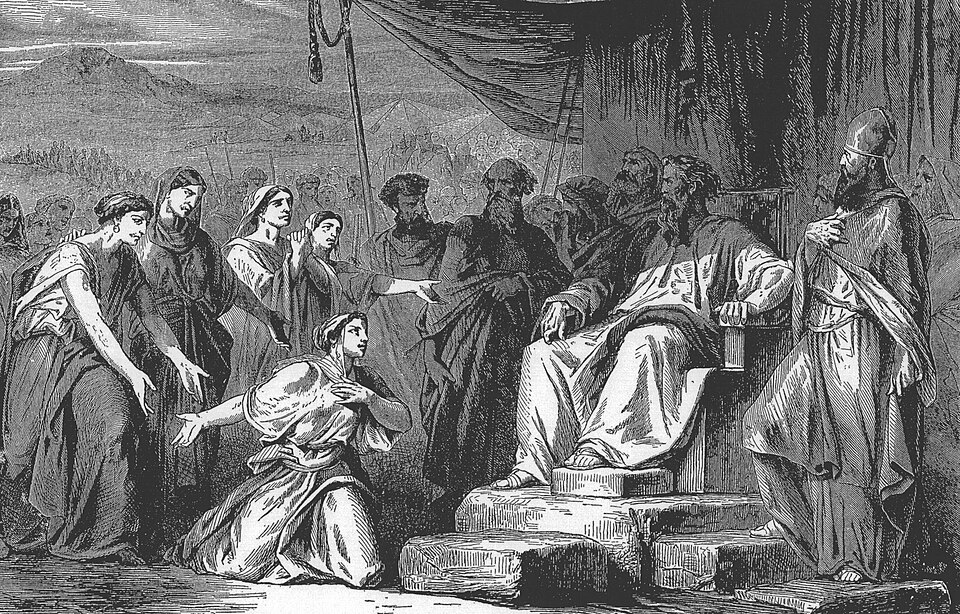
Zelophehad was the son of Hepher the son of Gilead, a descendant of Manasseh and Joseph (Numbers 27:1). He and his daughters Mahlah, Noah, Hoglah, Milcah, and Tirzah were first introduced as part of the census of Manasseh in Numbers 26:33, anticipating the events about to be described. Zelophehad’s daughters approached Moses, Eleazar ben Aaron the high priest, and the leaders of the assembly of Israel at the entrance to the tent of meeting, and made their appeal: their father Zelophehad had died in the wilderness, not as part of the rebellion of Korah, but for his own sin; they asked why his name should be lost among his family because he had no sons, and asked to be given a possession of the inherited lands around their relatives (Numbers 27:2-4).

Moses brought the case of the daughters of Zelophehad before YHWH, and YHWH validated their claim and commanded Moses to give them an inheritance among their father’s relatives which would belong to them (Numbers 27:6-7). YHWH then issued appropriate overall legislation in light of this case law regarding how inheritances should be handled: if a man dies without a son, his daughter inherits the estate; if he has no son or daughter, it should be given to his brothers; if he has no children or brothers, it should be given to his uncles; and if he has no children, brothers, or uncles, it should be given to the nearest relative to possess (Numbers 27:8-11).

The daughters of Zelophehad deserve commendation for their intentions, integrity, and witness. They proved willing to stand before the authorities on their own and to make their petition. They perceived the prospect of injustice done to their father’s legacy and perhaps peril for themselves in their present predicament. They were well vindicated by God: they were declared in the right and they were given a portion of an inheritance with the fellow members of the Hepherite clan of Gilead in Manasseh, and would eventually take their place among their relatives in the “western” portion of Manasseh west of the Jordan River (cf. Joshua 17:1-4).

At some point after this conversation and determination, the family heads of the Gileadites would approach Moses and the other leaders of Israel regarding this decision (Numbers 36:1). They recognized, and had no intention of challenging, how the daughters of Zelophehad were granted a portion of land among the Hepherites (Numbers 36:2). But they were concerned about what would happen to that land if the daughters of Zelophehad were to marry men from another tribe of Israel (Numbers 36:3-4).

Moses, by the word of YHWH, determined the leaders of the Gileadites were also in the right (Numbers 36:5). YHWH thus encouraged the daughters of Zelophehad to marry whomever they desired, but within their family’s tribe (Numbers 36:6). Moses then appropriately explained and expanded the scope of this case law: Israel should not allow their land inheritances to transfer from tribe to tribe, and so daughters who held possession of inheritances should marry within their tribe (Numbers 26:7-9). The daughters of Zelophehad would duly marry the sons of their uncles (thus, their cousins), and their land holdings would therefore remain within their same clan and tribe (Numbers 26:10-12).

We should not understand the latter episode as any kind of rebuke of what took place beforehand. Instead, we can perceive from this situation exactly how case law would be worked out in Israel. Inheritances were generally patrilineal, handed over from father to son. But what would happen if a man had no sons? The daughters of Zelophehad forced the question, and YHWH made provision for them to inherit in the midst of their father’s family. Well and good; the daughters of Zelophehad would inherit land. But what would happen to it if they married Israelites from other tribes? The Gileadite leaders forced that question, and YHWH through Moses further amended the inheritance law so that the land would remain in possession of the same tribe. The whole situation presumes living in the land and having land inheritances; we can imagine later Israelites would make appeal back to the situation of the daughters of Zelophehad when dealing with any similar inheritance situations which would have arisen, and such likely explains why the plight of the daughters of Zelophehad, and the later amendment to keep the land within the same tribe, were set forth.

At some point after originally addressing the plight of the daughters of Zelophehad, YHWH commanded Moses to go up on a mountain in the Abarim to see the land YHWH would give to the Israelites, and then afterward Moses would be gathered to his ancestors like his brother Aaron; this would take place on account of how Moses rebelled against YHWH’s command in the Wilderness of Zin and did not show YHWH as holy before Israel (Numbers 27:12-14; cf. Numbers 20:2-13).

Moses did not argue with YHWH, but he did encourage YHWH to appoint a man over the community of Israel to lead them, lest Israel become like sheep without a shepherd (Numbers 27:15-17). YHWH told Moses to take Joshua ben Nun, a man in whom was spirit/the Spirit, and lay his hands upon him, and to set him before Eleazar ben Aaron the high priest and the whole community, and thus commission him (Numbers 27:18-19). YHWH further commanded Moses to give Joshua some of his glory/honor, which we do well to understand as delegating some of his authority to Joshua, so the Israelites might obey him (Numbers 27:20). YHWH foresaw Joshua standing before Eleazar in the future to seek YHWH’s counsel by means of the Urim, commanding Israel appropriately, and they would follow his commands (Numbers 27:21). Moses would then do as YHWH commanded: he took Joshua, set him before Eleazar and the community, and laid hands on him and commissioned him to lead Israel after him (Numbers 27:22-23).

Whereas it would seem Moses immediately fulfilled the command to appoint Joshua as leader of Israel after him, he would not climb Mount Nebo, gaze upon the land of Canaan, and perish until Deuteronomy 34:1-7. We therefore best understand Numbers 27:12-14 as anticipating Moses’ eventual demise. It was likely brought up here as another result of the new census: everyone else from the generation YHWH delivered from Egypt who was going to perish before entering the land had perished except for Moses. The narrative in Numbers 27:12-23 has many points of connection with Aaron’s demise and the transfer of the high priesthood to his son Eleazar in Numbers 20:22-28, and for understandable reasons: both lay out the satisfaction of the consequences for the rebellion of Aaron and Moses and the provision which YHWH made for Israel afterward.

YHWH had specifically called Moses to lead the Israelites out of Egypt and into the land of Canaan (cf. Exodus 3:1-4:31). Moses would not be able to entirely fulfill his commission on account of his transgression but wanted to give confidence the commission would be fulfilled by another. Joshua ben Nun had already been the servant of Moses and would have been recognized as charismatic and a prospective leader for Israel (cf. Numbers 11:28, 27:18). But Joshua was not Moses, and would never be Moses. Only some of Moses’ glory/honor, thus authority, would come upon Joshua. Joshua would not speak with YHWH face to face like Moses had (cf. Numbers 12:8). Instead, Joshua would come before Eleazar the high priest for consultation. Eleazar, in turn, would consult YHWH via Urim: Urim, along with Thummim, were stones set in the “breastplate of decision,” and ostensibly Eleazar understood how to perceive YHWH’s determinations by means of Urim (Numbers 27:21; cf. Exodus 28:30).

These episodes regarding inheritance and transition in Numbers 27:1-23, 36:1-12 typify the whole situation of Israel in Numbers 26:1-36:13, and even through Deuteronomy and the beginning of the Book of Joshua. The generation YHWH delivered from Egyptian slavery had all perished save Caleb, Joshua, and Moses. The new generation looked forward to obtaining the fulfillment of all YHWH had promised. The transition was taking place, but was by no means complete. Aspects of the legacy of the former generation still required addressing, since some matters had not yet been resolved. The newer generation would need preparation and instruction before they could cross over. Zelophehad had appropriately died, but there was no reason his daughters should be cursed because he had no children; provision was made for his daughters to inherit his share of the promise. Moses would soon die, but Israel would continue to enjoy strong leadership under Joshua ben Nun. The past was being addressed; the future was being prepared. In many ways, we all live in this kind of space: addressing aspects of the legacy of those who have come before us, and seeking to prepare the way for those who will endure after us. May we therefore faithfully serve God in Christ through the Spirit and obtain the resurrection of life in Him!

Ethan R. Longhenry

Live as Gospel Citizens | The Voice 15.28: July 13, 2025

posted in: The Voice | 0

The Voice

Live as Gospel Citizens

Only conduct yourselves in a manner worthy of the gospel of Christ so that – whether I come and see you or whether I remain absent – I should hear that you are standing firm in one spirit, with one mind, by contending side by side for the faith of the gospel, and by not being intimidated in any way by your opponents. This is a sign of their destruction, but of your salvation – a sign which is from God. For it has been granted to you not only to believe in Christ but also to suffer for him, since you are encountering the same conflict that you saw me face and now hear that I am facing (Philippians 1:27-30).

Philippi was a Roman colony in Macedonia (part of modern Greece); Paul first visited the area and preached Jesus around 51 (cf. Acts 16:11-40). Paul wrote to the Christians in Philippi most likely around 60-61 from Rome while living under house arrest there (cf. Philippians 1:1). The church had appointed elders and had deacons serving them, and had sent Epaphroditus to provide support and service to Paul (cf. Philippians 1:1, 2:25-30, 4:18). Paul thanked the Philippian Christians for their joint participation in his ministry and prayed for them to abound in love and make good decisions to share in Jesus’ praise at His return (Philippians 1:2-11). He explained how his circumstances had worked to advance the Gospel; if he were to die, he would go and be with Christ, but he was confident he would continue to faithfully serve God, and the Philippian Christians, while in the body (Philippians 1:12-26).

It was customary to maintain a propositio in Greco-Roman letters: a concise statement in which the author would present his primary point regarding what he would be discussing. We might call it the proposition or thesis. True to form, Paul set forth his propositio to the Philippian Christians in Philippians 1:27:30.

Paul began with his primary emphasis, the point from which the rest of the propositio, and his Letter to the Philippians, would flow: to politeuesthe in a way worthy of the Gospel of Christ (Philippians 1:27). Politeuesthe literally means “to live as citizens,” thus, to reflect the behavior, integrity, and standards of a free citizen in a city or state. Thus, to live as a citizen of the Gospel of Christ would demand to live according to the behavior, integrity and standards which God has made known in Christ through the Spirit; the NET translation of “conduct yourselves in a manner worthy of the Gospel of Christ” well conveys the point.

But Paul’s appeal for the Philippian Christians to live as citizens of the Gospel remains notable. When Paul wanted to convey something regarding the Christian life, he tended to use the standard metaphor of the way or journey, to walk in accordance with the Gospel, of Christ, and/or of the Spirit (e.g. Romans 8:1-11). Only in Philippians did Paul decide to go with the metaphor of citizen, and such was likely a very deliberate rhetorical decision. Philippi, as a Roman colony, was very proud and protective of its status; from the use of this image, it would seem many Philippian Christians were Roman citizens themselves, or, if nothing else, regarded citizenship quite highly.

To this end, Paul appealed to the Philippian Christians to live as citizens of the Gospel of Christ (Philippians 1:27). It would be highly unlikely for Paul to use the metaphor if he wanted to cast aspersions on the concept of citizenship or holding citizenship within an earthly nation-state; nevertheless, he was also, at some level, contrasting their Roman citizenship with citizenship in the Kingdom of God in Christ, which would be made explicit in Philippians 3:20-21. The Philippian Christians well understood what it meant to live appropriately as a Roman citizen; Paul wanted them to take that understanding and reframe it around the Gospel of Christ. While Paul may not have been casting aspersions on having citizenship or being a citizen, he most assuredly was casting aspersions, to some degree, regarding the level of loyalty the Philippian Christians should have toward Rome. They should live as citizens, indeed; but of the Gospel of Christ. In many respects, being citizens of the Gospel of Christ would make them good Roman citizens; but in many others, especially in terms of honoring the gods and upholding the Roman hierarchy and “order of things,” the Philippian Christians would be challenged to maintain their loyalty to the ways of Jesus over the ways of Rome.

While the rest of the letter will detail what it would look like for the Philippian Christians to live as citizens of the Gospel of Christ, Paul would go on to immediately present a picture of what it looks like: whether he was able to visit the Philippians or would remain separated from them, he would hear they were standing firm in one spirit, with one mind, contending side by side for the faith of the Gospel, and not at all intimidated by opposition they would encounter (Philippians 1:27-28).

Paul therefore wanted the Philippian Christians to persevere in what they were already doing: to stand firm together in the Gospel. Both elements were quite important: the Philippian Christians needed to maintain and deepen their joint participation in Christ and with one another. Paul would soon expand upon standing firm in one spirit and with one mind in Philippians 2:1-11; his concern regarding contending side by side for the faith of the Gospel should illuminate our understanding of Philippians 3:1-21, and therefore we should not assume his warnings about those introducing “Judaizer” teachings were more theoretical than practical.

Paul did not want the Philippian Christians to be pturomenoi by opponents or adversaries. This is the only use of the Greek verb pturo in all of the New Testament; Classical authors would use the term to describe horses affrighted by something which startled them (Philippians 1:28). The term is certainly evocative, and it well communicates Paul’s concern. We cannot know exactly what kind of resistance or opposition the church in Philippi had experienced at the time, but especially in light of Philippians 3:1-16, it would not be hard to imagine some “Judaizing” teachers visiting the assemblies of the Philippian Christians, promoting their distortion of the Gospel and catching the Philippian Christians relatively unprepared for them. Philippi did not seem to have a very large Jewish population, and it is quite likely the Philippian Christians had not yet encountered the “Judaizers.”

Paul’s concern about these matters was manifest by his continued discussion: if the Philippian Christians were not at all afraid or intimidated by their opponents, it would be a sign of the destruction of the adversaries and the salvation of the Philippian Christians (Philippians 1:28). Paul then quite literally brought home the message of his own travails: the Philippian Christians were granted the opportunity not only to believe in Jesus but suffer with Him, experiencing the same conflict which they had watched Paul endure (Philippians 1:29-30).

Paul thus foresaw some level of suffering and difficulty for the Philippian Christians. Considering Paul would later warn the Philippian Christians regarding Judaizing teachers, and Paul’s most recent experiences of persecution and imprisonment came from the Jewish people, it would make the most sense for Paul to be warning the Philippian Christians regarding the kind of hostility and opposition the Philippian Christians would encounter from Jewish believers seeking to induce them to Judaize (cf. Acts 21:27-36, Philippians 3:2-3).

Perhaps Paul was concerned the Judaizing teachers would abuse the Philippian Christians in some way; perhaps he was concerned they would attempt to stir up the rest of Philippi against the Christians. We also cannot discount the possibility, however, that Paul did not have Jewish or Judaizing opponents in mind at all; perhaps the concern was with their fellow, yet pagan, Roman citizens in Philippi.

No matter who their opponents might be, Paul wanted the Philippian Christians to stand firm and be ready for them. The Philippian Christians had shared in Paul’s work, and thus his sufferings, through their support; Paul now expected they would also share in those sufferings more substantively. Thus it was all the more important for them to live as citizens of the Gospel of Christ and display their greater loyalty to Jesus over Caesar, come what may.

Paul’s propositio for his Letter to the Philippians appropriately summarized all he would go on to discuss in Philippians 2:1-4:23, and we do well to make appropriate reference to Philippians 1:27-30 when exploring the rest of the letter.

We are not Christians living in Philippi in the middle of the first century, but we can maintain great confidence Paul would also encourage us to live as citizens of the Gospel of Christ, to stand firm with one mind and spirit, contending side by side for the faith of the Gospel, and not proving intimidated by any form of opposition. We are to conduct ourselves in ways consistent with our joint participation and sharing in Christ; our primary loyalty must be to Jesus and His ways above and beyond the nation-state in which we might live. We must stand firm in the Gospel: we must defend the truth of God made known in the Gospel, yet above all we must embody its truth and display what the community of the people of God in Christ should look like. We can only do that together, contending and striving side by side. We will encounter opposition; it should not come as a surprise to us. But we should always glorify God in Christ in how we relate to opposition and adversity. Our citizenship is in heaven from which we await our Savior and the resurrection; may we conduct ourselves appropriately so we might share in it!

Ethan R. Longhenry

Gospel and Faith | The Voice 15.27: July 06, 2025

posted in: The Voice | 0

The Voice

The Gospel and Faith

The Gospel features all God has accomplished through the life, death, resurrection, ascension, lordship, and imminent return of Jesus of Nazareth, the Christ, the Son of God. We might well reckon the Gospel as good news, but what about it?

Those who had been with Jesus and bore witness to all God accomplished through Him expected their hearers who proved amenable to the story to believe it (cf. Acts 15:7). John the Evangelist wrote down his Gospel for this very purpose, so those who read might believe Jesus is the Christ, the Son of God, and by believing have life in His name (John 20:30-31).

A basic understanding of belief involves giving mental assent to a proposition. Thus, to believe in the Gospel demands we give mental acceptance to its reality: Jesus actually and truly lived, died, was raised from the dead, ascended to the Father, reigns as Lord and Christ, and will return soon (e.g. Acts 16:31, 1 Timothy 3:16).

As a form of mental acceptance, belief cannot be perceived by anyone else. Therefore, it has always been expected for those who have come to believe in the Gospel to affirm and confirm that belief by means of oral confession before witnesses, declaring their confidence in Jesus as the Christ, the Son of God, and by doing so all it entails (Romans 10:9-10, 1 Timothy 6:12-13).

Paul understood how the information encoded within the proclamation of Jesus’ life, death, resurrection, ascension, lordship, and imminent return bore witness to God’s actual work in Jesus the Christ which provided the means of deliverance from bondage to sin and death, reconciliation with God, the reception of the Spirit of God, and the means by which one might become conformed to the image of Jesus (cf. Romans 1:16-17, 8:1-39, Colossians 2:15, etc.). As we have seen, we absolutely must give mental assent to the substantive, actual reality of all God has accomplished in Jesus with verbal confirmation thereof; and yet merely mentally accepting it and confirming it does not, in and of themselves, change much of anything. As James the Lord’s brother declared, the demons also believe, and shudder (James 2:19)! Demons would also confess Jesus as the Christ, the Son of God (e.g. Luke 8:28, Acts 16:17). Yet no one suggests demons have found salvation in Jesus because they believe Jesus is the Christ and confess Him in the presence of many witnesses.

Paul, James, and other early Christian witnesses would therefore have those who would believe in Jesus go well beyond mere mental acceptance with verbal confirmation: he would have them cultivate and develop greater confidence and trust in God in Christ through the Spirit. We tend to speak of that confidence and trust as “faith.”

In Romans 1:16-17, Paul well associated and connected the Gospel and faith:

For I am not ashamed of the gospel, for it is God’s power for salvation to everyone who believes, to the Jew first and also to the Greek. For the righteousness of God is revealed in the gospel from faith to faith, just as it is written, “The righteous by faith will live.”

Paul considered God as having revealed, or made known, His justice/righteousness in the Gospel “from faith to faith” (Romans 1:17). God has worked powerfully in Christ and through the Spirit so those who would believe might be saved. He was under no obligation to do so; we have all sinned and fallen short of His glory, and all deserved condemnation for our transgressions (Romans 3:23, 6:23). God displayed His unimaginably immense love for us in Jesus’ life and death, especially since Jesus died to reconcile us while we were sinners (Romans 5:6-11, 1 John 4:7-21). We were unworthy in every respect; nevertheless, God found satisfaction for justice through what Jesus suffered so believers in Jesus could be reconciled and display His righteousness in them (cf. Romans 8:1-11).

In Romans 3:21-22, Paul spoke regarding how God’s righteousness was manifested apart from the Law of Moses through the “faith of Jesus Christ.” The interpretive challenge of Romans 3:22 involves how we understand what Paul meant by the “faith of Jesus Christ”: did he intend an “objective genitive,” and thus was speaking of the believer’s faith in Jesus Christ, or a “subjective genitive,” therefore speaking of the faith, or perhaps better faithfulness, of Jesus Christ Himself? Even though interpreters remain divided on the question, we can, and must, affirm how both options remain true and valid.

The Gospel bears witness to the faithfulness of Jesus Christ. To be “faithful” can be understood as “full of faith,” but really involves proving both trustworthy and comporting oneself fully according to one’s commitment and convictions. The Hebrews author testified to Jesus’ faithfulness as a Son in the house of His Father (Hebrews 3:6). Jesus came to do the will of His Father, and He did what God would have Him do; in this way He fulfilled all that which God had promised to Israel and to all regarding His Son, the Christ (Luke 24:44, John 17:4).

In this way we can understand how the Gospel reveals the righteousness of God “from faith” in Romans 1:17: God has been faithful and acted faithfully in Christ. Just as Israel was given every reason to maintain confidence in the authority, power, and covenant loyalty of God because God rescued them out of Egyptian slavery, sustained them in the wilderness, and gave them the land of Canaan, so those who would believe in Jesus today have been given every reason to maintain confidence in the authority, power, and covenant loyalty of God in Christ because Jesus lived, died, was raised, ascended to the Father, reigns as Lord and Christ, and will return soon, all of which fulfill all the promises God had made for generations.

And since Christ Jesus proved faithful, and has thus become the Pioneer of salvation for all who would follow Him, in Him believers can manifest God’s righteousness by faith. Such a manifestation must go well beyond mental acceptance of the propositions of the Gospel and the verbal affirmation thereof; as Paul cited from Habakkuk 2:4, the righteous ones will live by (their) faith.

To live by faith demands demonstrating full trust in Jesus as Lord and Christ. Plenty of people can say they believe Jesus is Lord and Christ and yet continue to think, feel, and act as if they are the ones in charge, or in ways completely consistent with their cultural context. To live by faith means we give more than mere lip service to Jesus Christ our Lord, the Son of God: it means we seek to follow Jesus and His ways.

We must therefore change our minds and hearts to no longer maintain those thoughts, feelings, and behaviors which work against what God has accomplished in Jesus so we can instead strive to maintain the thoughts, feelings, and actions which demonstrate our commitment to Jesus as Lord and to follow Him; the New Testament calls this change repentance (cf. Acts 2:38, 17:30-31). Believers are also called by Jesus to submit to immersion in water in the name of the Father, the Son, and the Holy Spirit for the remission of sin in order to put on Christ, be able to walk in newness of life, and to receive the Holy Spirit (cf. Matthew 28:18-20, Acts 2:38-39, Romans 6:1-11, Galatians 3:27). In this way Christians begin to prove faithful to the Gospel and its message.

And from then on Christians must persevere in following Jesus and His ways. What does it look like to follow Jesus and His ways? He has made them known in the Gospel (John 14:6, 20:30-31)! In short, the Way of Jesus looks like a humble life of faithful service, seeking the welfare of others and not merely our own, to prove willing to suffer evil without responding in kind, jointly participating and sharing in life with fellow believers in Jesus, and affirming our confession of Jesus as Lord despite any and all hostility, persecution, and punishment which may come from the authorities or others (cf. Romans 12:1-21, Hebrews 13:1-13, etc.).

Some aspects of what it means to follow Jesus might not prove terribly challenging for many to maintain, especially in those areas which do not conflict with the socio-cultural consensus of the day. Nevertheless, the demands of what it means to follow Jesus will always come into conflict, in some ways and forms, with any and every socio-cultural consensus, and it is at these points which the loyalty of any given person will be tested.

We must strive to prove faithful to God in Christ through the Spirit: God has given of His Spirit so His fruit might become manifest in us (cf. Galatians 5:22-24, 2 Thessalonians 2:13). We must cultivate thoughts, feelings, and actions which conform to what God has made known in Christ and thus prove faithful and obedient to Jesus; all such endeavors must, first and foremost, involve entrusting ourselves to God in Christ through the Spirit, and submitting our ways and will to Him (Romans 6:1-23, Galatians 2:20).

Therefore, we cannot imagine we have the capacity to prove faithful merely by our own unaided efforts, but we also cannot imagine we can prove faithful without involving anything of our own efforts, as Paul well explicated in his paradoxical affirmations of Philippians 2:12-13.

The Gospel, therefore, is inextricably bound up in matters of faith. We must display faith in the Gospel, which means we accept and affirm the reality of Jesus’ life, death, resurrection, ascension, lordship, and imminent return. The Gospel makes known God’s faithfulness in Christ, and Jesus’ own faithfulness: in Christ God fulfilled all He had promised, and Jesus lived and died trusting in God and fully manifesting His commitment and conviction in God through what He suffered. God thus bore witness to His justice and righteousness in faithfulness, providing a means of reconciliation despite our sinfulness and unworthiness. As a result, we have been given every reason to trust in God and His faithfulness in Jesus, and therefore should cultivate and develop trust in God in Christ through the Spirit, living according to the way and pattern of Jesus’ life and death so we might share in His resurrection. May we uphold the faith of God in Christ in the Gospel, live by faith according to what has been made known in the Gospel, and share in the resurrection of life promised by God in Christ when He returns!

Ethan R. Longhenry

Prayer of Manasseh | The Voice 15.26: June 29, 2025

posted in: The Voice | 0

The Voice

The Prayer of Manasseh

What, exactly, was the substance of Manasseh king of Judah’s prayer before YHWH? While many among the people of God have most likely asked this question, someone in antiquity wrote down what they believed the prayer would have been which we now deem the apocryphal Prayer of Manasseh.

The historical Manasseh ben Hezekiah, king of Judah, reigned over Judah for 55 years (ca. 697-643 BCE; 2 Kings 21:1-18, 2 Chronicles 33:1-20). According to the Kings narrative, Manasseh was a most wicked king of Judah, introducing service to foreign gods into the Temple complex in Jerusalem itself; on account of what Manasseh did, YHWH condemned Jerusalem and the Temple to destruction just as He did to Israel (2 Kings 21:1-18).

The Chronicler also bore witness to Manasseh’s many sins, denouncing him as encouraging the Judahites to sin more than the nations which YHWH had destroyed before Israel (2 Chronicles 33:1-9). Yet the Chronicler would also make known how YHWH brought the Assyrians against Manasseh and Judah, and they captured him and carried him away to Babylon (2 Chronicles 33:10-11). The Chronicler then recorded Manasseh’s response:

In his pain Manasseh asked YHWH his God for mercy and truly humbled himself before the God of his ancestors. When he prayed to YHWH, YHWH responded to him and answered favorably his cry for mercy.
YHWH brought him back to Jerusalem to his kingdom. Then Manasseh realized that YHWH is the true God (2 Chronicles 33:12-13).

According to the Chronicler, Manasseh returned to Jerusalem, heightened its walls, removed the service to foreign gods from the Temple, and exhorted the Judahites to serve YHWH God of Israel (2 Chronicles 33:14-17). In concluding his account of Manasseh’s reign, the Chronicler spoke of his sources:

The rest of the events of Manasseh’s reign, including his prayer to his God and the words the prophets spoke to him in the name of YHWH God of Israel, are recorded in the Annals of the Kings of Israel. The Annals of the Prophets include his prayer, give an account of how YHWH responded to it, record all his sins and unfaithful acts, and identify the sites where he built high places and erected Asherah poles and idols before he humbled himself (2 Chronicles 33:18-19).

We might associate the Annals of the Kings of Israel with the Books of Kings, but while 2 Kings 21:1-18 bore witness to Manasseh’s reign and the words the prophets spoke to him, none of our manuscripts preserve his prayer. We are left to believe the Annals of the Kings of Israel, if nothing else, included other information beyond what we can see in 1 and 2 Kings, and has been lost to us. The same would be true for the Annals of the Prophets: anything regarding Manasseh’s sins, his prayer, and YHWH’s response have been lost to us.

The record of Manasseh’s prayer was not just lost to us; it was most likely lost well in antiquity, early in the Second Temple Period. We can perceive this not only because no later source describes anything in the Annals of the Kings of Israel or the Annals of the Prophets, and also because two different prayers purported to be Manasseh’s have come down to us: a prayer in Hebrew as part of the Dead Sea Scrolls (4Q381:17), and a Greek text called the Prayer of Manasseh which became part of some forms of the Septuagint. We will consider this latter Prayer of Manasseh in greater detail.

The Prayer of Manasseh has been preserved in Greek, as well as in Syriac, Old Slavonic, Ethiopic, Armenian, and Latin translations; many scholars believe it was originally a Greek composition, but some argue for a Hebrew original. All agree the Prayer of Manasseh was certainly written during the Second Temple Period: no later than the destruction of Jerusalem in 70 CE, and most likely between 200-1 BCE.

This is the Prayer of Manasseh as translated in the New Revised Standard Version of the Apocrypha (NRSVA):

O Lord Almighty, God of our ancestors, of Abraham and Isaac and Jacob and of their righteous offspring; you who made heaven and earth with all their order; who shackled the sea by your word of command, who confined the deep and sealed it with your terrible and glorious name; at whom all things shudder, and tremble before your power, for your glorious splendor cannot be borne, and the wrath of your threat to sinners is unendurable; yet immeasurable and unsearchable is your promised mercy, for you are the Lord Most High, of great compassion, long-suffering, and very merciful, and you relent at human suffering.

O Lord, according to your great goodness you have promised repentance and forgiveness to those who have sinned against you, and in the multitude of your mercies you have appointed repentance for sinners, so that they may be saved. Therefore you, O Lord, God of the righteous, have not appointed repentance for the righteous, for Abraham and Isaac and Jacob, who did not sin against you, but you have appointed repentance for me, who am a sinner. For the sins I have committed are more in number than the sand of the sea; my transgressions are multiplied, O Lord, they are multiplied! I am not worthy to look up and see the height of heaven because of the multitude of my iniquities. I am weighted down with many an iron fetter, so that I am rejected because of my sins, and I have no relief; for I have provoked your wrath and have done what is evil in your sight, setting up abominations and multiplying offenses.

And now I bend the knee of my heart, imploring you for your kindness. I have sinned, O Lord, I have sinned, and I acknowledge my transgressions. I earnestly implore you, forgive me, O Lord, forgive me! Do not destroy me with my transgressions! Do not be angry with me forever or store up evil for me; do not condemn me to the depths of the earth.

For you, O Lord, are the God of those who repent, and in me you will manifest your goodness; for, unworthy as I am, you will save me according to your great mercy, and I will praise you continually all the days of my life. For all the host of heaven sings your praise, and yours is the glory forever. Amen.

The Prayer of Manasseh provided no narrative or editorial introduction; at no point within the text was Manasseh explicitly mentioned. Instead, the Prayer of Manasseh begins by invoking God as the Lord Almighty, God of Abraham, Isaac, Jacob, and their offspring, praising God as the Creator to whom all things are subject, full of splendor but terrifying with wrath toward sinners, and yet also deeply merciful (Prayer of Manasseh 1:1-6). The Prayer of Manasseh highlighted God’s compassion, longsuffering, and mercy as the Lord Most High, having promised repentance and forgiveness to those who sinned against him (Prayer of Manasseh 1:7). The Prayer of Manasseh would suggest God did not appoint repentance for the righteous, like Abraham, Isaac, and Jacob, but repentance for the author, a sinner who sinned profoundly against God; he could not even look up to God on account of all his iniquities; he was weighed down with his sins and provoked God’s wrath against him on account of his idolatry (the strongest point of association between the material in the prayer and Manasseh; Prayer of Manasseh 1:8-10). The Prayer of Manasseh then set forth great contrition: the one praying would bend the knee of his heart, imploring God’s kindness, confessing he had sinned, begging for forgiveness, and asking to avoid destruction, God’s anger, and condemnation (Prayer of Manasseh 1:11-13). The Prayer of Manasseh concluded with the expectation the prayer would be heard and accepted: the one praying confessed the Lord as the God of those who repent, and through him God would manifest His goodness, and would save him despite his unworthiness; the one praying would praise God continually for the rest of his life along with the host of heaven (Prayer of Manasseh 1:13-15).

There is no evidence the Prayer of Manasseh was a seventh century composition by Manasseh ben Hezekiah, king of Judah, or recorded as part of the Annals of the Kings of Israel or the Annals of the Prophets. Instead, in Jewish and all Christian traditions, the Prayer of Manasseh is reckoned as apocryphal and pseudepigraphal: not actually written by Manasseh ben Hezekiah, but by someone later imagining what Manasseh might have prayed, and preserved as part of some editions of the Greek Septuagint.

While most believe the author of the Prayer of Manasseh was most likely a Jewish person of the later Second Temple Period, Jewish tradition overall did not make much of the Prayer of Manasseh, although a copy of it in Hebrew was found as part of the Cairo Genizah. The Prayer of Manasseh would feature more prominently in many Christian traditions. In the Ethiopian Bible and some of the earliest editions of the Latin Vulgate, the Prayer of Manasseh was placed either within or at the end of 2 Chronicles. More often, the Prayer of Manasseh would be placed among other apocryphal or deuterocanonical works, as in the Greek Septuagint, later editions of the Vulgate, Luther’s translation of the Bible in German, and some of the earliest English Bible translations, including the Apocrypha of the 1611 King James Version. The Eastern and Oriental Orthodox Churches consider the Prayer of Manasseh to be deuterocanonical; the Roman Catholic Church did not include the Prayer of Manasseh among the deuterocanonical works it considered part of the canon of Scripture, but may consider it profitable for devotional purposes.

What should we make of the Prayer of Manasseh? We have every reason to believe Manasseh ben Hezekiah, king of Judah, prayed a prayer before YHWH in contrition and repentance for all the abominations, idolatry, and immorality he himself perpetrated and also encouraged the Judahites to perpetrate. We also have every reason to believe the prayer Manasseh ben Hezekiah prayed was preserved, along with other details and information surrounding his life and the prayer, as part of the Annals of the Kings of Israel and the Annals of the Prophets.

But we have no manuscripts of, or even other texts referencing, the Annals of the Kings of Israel or the Annals of the Prophets. Since two very different prayers have come down to us purporting to be what Manasseh ben Hezekiah prayed, it proves challenging to even entertain the possibility one of them might preserve the prayer from either source mentioned by the Chronicler. It would make more sense to believe both prayers were written by later Jewish people who were imagining what Manasseh ben Hezekiah would have prayed in that situation.

Therefore, while no doubt some sincere and faithful Christians have believed the Prayer of Manasseh represents the prayer Manasseh ben Hezekiah actually prayed, it is more likely a later Greek apocryphal composition. The overall theological framework and expressions within the prayer prove far more aligned with the later Second Temple Period than the days of the Davidic kings.

So if the Prayer of Manasseh was not what Manasseh ben Hezekiah actually prayed, why should we give it any regard? For generations, Christians have appreciated the Prayer of Manasseh for devotional purposes: just as its author imagined himself as giving voice to what Manasseh ben Hezekiah would have prayed, so we all likewise can consider the Prayer of Manasseh in giving voice to us to ask God for forgiveness. The vast majority of the Prayer of Manasseh presents solid theology and provides compelling expressions of contrition before God. The only troublesome premises within the Prayer of Manasseh would involve the suggestion the righteous would never need repentance, or that Abraham, Isaac, and Jacob did not sin (cf. Prayer of Manasseh 1:8): the Scriptures appropriately understand all people, including Abraham, Isaac, and Jacob, to have sinned and fallen short of God’s glory, and thus even the “righteous” will at times need to repent of sin (cf. Ecclesiastes 7:20, Romans 3:23, 1 John 1:7-10).

The Prayer of Manasseh, therefore, was not actually spoken by Manasseh ben Hezekiah, and was not what was recorded in the Annals of the Kings of Israel or the Annals of the Prophets. The Prayer of Manasseh should not be considered canonical or inspired Scripture. But the Prayer of Manasseh remains a devotional composition of the Second Temple Period which can provide benefit to Christians to this day. Christians can appropriate many aspects of the Prayer of Manasseh in their prayers of contrition and repentance before God. The Prayer of Manasseh expertly framed the appeal for contrition and repentance within a framework which established God’s great majesty, compassion, kindness, grace, and mercy, along with expressions anticipating the acceptance of the prayer and the desire to continue praising God among His people and the host of heaven. After all, who among us could not speak out the vast majority of the Prayer of Manasseh in good conscience as an appeal to God to be forgiven of our sins? May we well consider the Prayer of Manasseh as an exemplar of expressing contrition, repentance, and asking God for the forgiveness of our sins, appropriate it appropriately, and continue to seek to serve God in Christ through the Spirit!

Ethan R. Longhenry