Emphasis | The Voice 13.40: October 01, 2023

posted in: The Voice | 0

The Voice

Emphasis

With what should I enter YHWH’s presence? With what should I bow before the sovereign God? Should I enter his presence with burnt offerings, with year-old calves? Will YHWH accept a thousand rams, or ten thousand streams of olive oil? Should I give him my firstborn child as payment for my rebellion, my offspring – my own flesh and blood – for my sin?
He has told you, O man, what is good, and what YHWH really wants from you: He wants you to carry out justice, to love faithfulness, and to live obediently before your God (Micah 6:6-8).

We understand well how the truth of God in Christ through the Spirit involves the witness of God regarding Himself and His people in the Scriptures. We recognize the importance of insisting on the “whole counsel of God” (cf. Acts 20:27). We seek to discern this whole counsel of God by means of the substance of what has been revealed. Yet we tend to expose much about ourselves in terms of what aspects of that truth we emphasize.

Emphasis involves placing special value or importance on something, or an aspect of something. Emphasis is related to focus and priority: that upon which we focus is something we tend to emphasize, and our priorities tend to define that which we emphasize.

Ironically emphasis has often been neglected both in terms of how we understand what God has made known in Christ and how we embody and proclaim the faith. We have reasoned how truth is truth whether much or little is made of it. We have seen how some have attempted to justify beliefs and practices not consistent with what God has revealed in Scripture by undermining aspects of the truth on which little, if any, emphasis was placed in the New Testament. Furthermore, emphasis seems subjective, and thus at variance with the quest to ascertain and uphold objective truth. We do not want to be seen as “playing favorites” with the truth and imagine we can consistently and fully uphold everything which is true in God in Christ through the Spirit.

Any attempt to deny the existence and presence of emphasis in Christian faith and practice proves a fool’s errand. We might imagine we uphold the full truth of God in Christ through the Spirit in a consistent and equal manner, but in this we deceive ourselves. We are all finite created beings; our sense impressions and our brains can only discern and process so much. We only have so many hours in a day and so much effort we can expend on anything and everything in our lives. We tend to understand this better in terms of focus and priority than emphasis. By definition, if we focus on something or some things, we comparatively neglect that upon which we do not focus. Prioritization, by definition, represents a judgment by which certain things are reckoned as more important or are to be privileged over other things. Thus, by definition, we cannot focus on or prioritize everything. Likewise, we do not, and cannot, represent the faith and practice which embodies Jesus without emphasis.

Yet even within the witness of God in Christ through the Spirit as witnessed in the Scriptures we find emphasis. Not only that, we find God condemning His people for maintaining misplaced emphases.

In Matthew 5:19 Jesus, in indicting the Pharisees, condemned anyone who would violate the “least” of the commandments; if there are “least” commandments, there also exist “greater” commandments, and “greater” and “least” are judgments of emphasis. In Matthew 23:23, He condemned the Pharisees for tithing in minutiae while neglecting justice, mercy, and faithfulness, deemed that which was more important in the Law. Yes, Jesus did say the Pharisees were right to tithe in the matters of minutiae; recognizing emphasis by no means commends or justifies disobedience in more comparatively minor matters. Yet the force of the indictment remains: the Pharisees had made much of little and little of much, or, as Jesus would put it, they were straining gnats while swallowing camels (Matthew 23:24).

Christians often make much of Micah 6:6-8, and for good reason; in it Micah recognized a trend which bedeviled Israel for generations. As far as we can tell, throughout the period of the kings, Judah was fastidious about offering the requisite sacrifices before YHWH. The rulers, priests, many of the “prophets,” and the people thus imagined they maintained full standing before YHWH because they continued to offer the sacrifices YHWH commanded them. Micah asks if such sacrifices are sufficient to really obtain YHWH’s favor: what is good, and what YHWH really wants from His people, is to do justice, love faithfulness, and live obediently before God.

Samuel similarly rebuked Saul in 1 Samuel 15:22. Amos told Israel how YHWH was tired of their sacrifices and songs and reminded them how they did not offer sacrifices and grain offerings in the Wilderness; what YHWH really wanted was justice to run like waters and righteousness like a mighty stream (Amos 5:21-27). Isaiah had a similar word for post-exilic Judah who imagined their fasting would get YHWH’s attention: Isaiah made it very clear how the “fast” YHWH wanted was for them to remove chains, to tear away the yoke, to set free the oppressed, to share food with the hungry, shelter the homeless and the oppressed, and clothe the naked (Isaiah 58:1-9).

The Pharisees, therefore, were doing just what their ancestors had done: they focused on, or emphasized, what was “objective,” easily discernible and measurable, and were satisfied. In the process they had entirely missed the point, just as their ancestors had done. They had imagined God was not only pleased with their fastidious observance of certain laws but that such would justify them in the end, just like their ancestors imagined God was pleased with their sacrifices and that such would justify them. In both instances God provided almost entirely the same rebuke: you have misplaced your emphasis. God wanted them to uphold what was just, right, fair, and good, and to use what they had to alleviate the exploitation and oppression of the powers around them. Sacrifices, fasting, and tithes had their place. Yet they were not YHWH’s intended emphasis, focus, or priority.

To this very day the same critique can be leveled among the people of God. The people of God today focus on and emphasize what is “objective,” easily discernible and measurable, and are satisfied. Assembling with the saints, giving on the first day of the week, and wearing approved clothing styles are today’s versions of sacrifices, fasting, and tithes. And, at the same time, justice, mercy, and faithfulness do not receive the emphasis.

Such is not restricted to matters of practice; even in terms of beliefs and doctrines the people of God have maintained misplaced emphases. Much is made regarding preaching “the distinctives,” and much emphasis, focus, and priority is placed upon the plan of salvation, the organization of the church, the nature of the acts of the assembly, and upon where others have either fallen short of or have gone on beyond what God has made known regarding the Kingdom of Jesus through His Apostles. Not a few equate “the Gospel” with such issues.

We do well to instead consider how Paul himself approached matters. In every letter he returns to what God has accomplished in Jesus to anchor and ground all of his concerns, doctrinal or practical. Paul’s emphasis is on the Christ of God crucified and risen, and everything else flows from that source.

Thus, for Christians, what should be our emphasis? Jesus should be our emphasis, and we should emphasize what Jesus would have us emphasize. Even if we all want to take it for granted, the Gospel for the past two thousand years has been the good news of what God has accomplished in Jesus’ life, death, resurrection, ascension, lordship, and preparation for His imminent return, and that will remain the Gospel until He returns and God is made all in all. Jesus’ emphasis was on love, humility, and compassion, and such motivated true faithfulness and obedience. Such love was not pretense but substantive, and it bore the appropriate fruit.

Does this mean we should entirely neglect or suppress that which was not emphasized? Absolutely not! Israel was to fast, offer sacrifices, and tithe in everything; Christians should assemble with the saints, give on the first day of the week, wear clothing which glorifies God in Christ, and seek in all details to uphold God’s purposes for individuals and congregations in the Kingdom of Jesus. Yet in emphasizing and focusing on the details, Israel was found lacking and guilty before God; we run the same risk as Christians, and we should be no less concerned about the prospect of the judgment of God than they were.

Thus we do well to recover a healthy sense of emphasis in our Christian faith and practice. We must understand how emphasis is a matter of truth: if we say we follow God, but we maintain misplaced emphases, we easily deceive ourselves and will find ourselves as liable to judgment as did Israel of old. It is not for us to determine what should be emphasized, or the framework through which we should understand all things; it is for us in humility to submit ourselves to the emphases laid out for us by God in Christ through the Spirit, to emphasize Jesus and the Gospel over all things: to recognize and accomplish the weightier provisions of faithfulness, justice, love, and mercy over the more “objective” and easily definable yet comparatively more minor aspects of faithful observance of the Lord’s purposes, and to remember what makes us “distinctive” has far less to do with matters of church polity and much more about being transformed by the good news of Jesus’ life, death, resurrection, ascension, lordship, and the prospect of His imminent return, and understanding all things through that prism. May we not only uphold the truth of God in Christ through the Spirit but also maintain appropriate emphasis in our faith and practice so we might obtain the resurrection of life!

Ethan R. Longhenry

The Tyranny of the Present | The Voice 13.39: September 24, 2023

posted in: The Voice | 0

The Voice

The Tyranny of the Present

The story is told of the man who believed that God would tell him exactly what to do by opening his Bible to a random page and placing his finger on a text. This went quite well for him until the day he opened his Bible and placed his finger upon Matthew 27:5: “and he went away and hanged himself.” He was sure he made a mistake, and so he tried the procedure again, and this time his finger fell on Luke 10:37: “go and do thou likewise.” Quite concerned, he tried a third time, and this time the Bible opened to John 13:27: “what thou doest, do quickly.” So he went and hanged himself!

We certainly hope this story is fictitious, yet it well illustrates the difficulties present in haphazard forms of Bible interpretation. While most people see the fallacy in attempting to ascertain God’s will for their lives through opening the Bible randomly and putting their finger on a passage, many fall prey to its near relation: interpreting the Bible without any regard to its original context as if everything found in its pages were written directly to them. We can call such a phenomenon the “tyranny of the present.” The present is “tyrannical” inasmuch as it is the default means by which we attempt to understand things. We naturally seek to understand all things according to our own perspective; in order to understand what a given text would mean to those to whom it was originally written takes more time and effort.

Much of what is written in the New Testament, especially in terms of moral exhortation, is universal; we have as much a need to avoid the works of the flesh and to manifest the fruit of the Spirit as the Galatians did 2,000 years ago (cf. Galatians 5:17-24). We can make sense of most of Jesus’ teachings in our own day and time as well. Even when we understand a text in its context, we ought to then seek to understand how we can apply the message to our own time and place, as has been done for generations (Nehemiah 8:1-8, Romans 15:4, 1 Corinthians 10:1-12). Nevertheless, we must avoid the temptation to immediately start thinking of how Bible texts may apply to us without first respecting its context; not a few false doctrines have been perpetrated on account of the tyranny of the present!

Distortions in the interpretation of Daniel, Matthew 24:1-25:36, and Revelation throughout time provide the clearest warning regarding the tyranny of the present. Many among dispensational premillennialists today are convinced, in all sincerity, that Daniel, Jesus, and John are speaking about an upcoming tribulation involving helicopters, nuclear weapons, and the armies of Russia, China, and Israel. Each successive President of the United States is reckoned by some to be the Antichrist. Jesus was supposed to return in 2000 or 2012. Yet this is nothing new: Hitler, Kaiser Wilhelm II, Napoleon, the popes, and many others before them were considered the Antichrist in their own day and age. Jesus was supposed to return in 1975, 1914, 1843-1844, 1000, and many other dates that have come and gone as well. Each successive generation is convinced that the end of the world is happening in their own day; whereas one generation will be right by default when the Lord returns, all generations since the first century have been wrong. Yet that has not stopped people from being firmly convinced that current events represent the end of time, and that John saw what would happen in their own generation!

The tyranny of the present is not just found in eschatological matters. Many read the Law of Moses and other aspects of the Old Testament as if they are still subject to that legislation despite the change in covenant and law under Jesus (Ephesians 2:11-18, Colossians 2:14-17, Hebrews 7:12-9:26). Many see the work of the Spirit empowering believers to speak in tongues and prophesy in the first century and believe that they should be able to receive the same abilities, despite the completion of the revelation regarding the Gospel of Jesus and our ability to learn of Him from the written Word, a privilege not yet realized at that time (1 Corinthians 13:8-10).

As Bible students we always do well to remember that nothing in the Bible was written directly to us; Peter and Paul did not write to the churches of America, nor did they speak or write in Elizabethan or modern English. Likewise, if our interpretation of a text cannot make sense of what the original author would be writing to his original audience, then our interpretation has not come to a good understanding of the text. We must resist the tyranny of the present, somehow confident that the Bible is really written to us today, and instead seek to understand what God was communicating to Israel and then the early church and ascertain how we may apply those messages appropriately to our own time and place. Let us seek to understand the Bible in its own context, and learn of God from its pages, and serve Him in the Kingdom of His Son!

Ethan R. Longhenry

Time and Chance | The Voice 13.38: September 17, 2023

posted in: The Voice | 0

The Voice

Time and Chance

Again, I observed this on the earth: the race is not always won by the swiftest, the battle is not always won by the strongest; prosperity does not always belong to those who are the wisest, wealth does not always belong to those who are the most discerning, nor does success always come to those with the most knowledge – for time and chance may overcome them all.
Surely, no one knows his appointed time! Like fish that are caught in a deadly net, and like birds that are caught in a snare – just like them, all people are ensnared at an unfortunate time that falls upon them suddenly (Ecclesiastes 9:11-12).

Why do things take place as they do? Are they all actively determined by God? How much is due to simple happenstance, and what does that say about God in our lives?

Throughout Ecclesiastes 1:1-9:10 the Preacher meditated upon the hevel of life under the sun: all is vain, futile – truly absurd. He compares most human endeavors toward meaning as “chasing after wind”: people pursue pleasure, wealth, wisdom, or other things looking for ultimate purpose and satisfaction and will be disappointed and frustrated by all of them. To rage against such truths is itself futile and striving after wind. God understands better than we do. In Ecclesiastes 8:17-9:10 he has been meditating on the finite nature of humans and the universality of death. He thus commended enjoying relationships, food, and work, to not take them for granted, and to resist seeking to find immortality in any aspect of life “under the sun.”

The Preacher continued with more relevant observations. The person with the best skill may not always win the race; battles are not always won by the side with material and numerical advantages. The wisest and most discerning may not be the most prosperous and wealthy. Knowledge is no guarantee of success. Despite all the best training and preparation, one may still prove unsuccessful in their endeavors. In short, life does not come with guarantees; time and chance happen to everyone (Ecclesiastes 9:11).

Time and chance do not only feature in terms of human exploits; they also affect our very existence. We do not know the appointed time of great misfortune and/or our death; just like the fish or bird were going about their lives until they got caught in the net or snare, so are we when misfortune and/or death comes (Ecclesiastes 9:12).

The Preacher has thus exposed two of the most pernicious lies we tell ourselves: “it might happen there, but it will never happen here,” and, “it may happen to them, but it will not happen to me.” We certainly understand why we might want to believe these lies; we all want to avoid and escape disaster, misfortune, and death. If we can create some kind of distance between ourselves and unfortunate events and circumstances, we can assure ourselves we are fine and well.

Yet time and chance can overcome any of us. We can treat our body well and do those things which should support health; we might get sick or suffer a heart attack and die anyway. We can invest much in education but still not succeed in our endeavors. All kinds of athletes prepare and train well, perhaps becoming acknowledged as the greatest, or one of the greatest, athletes of their discipline; and yet they might still lose their competitions. Military history is filled with the stories of large armies brought low and defeated by far smaller groups; likewise, the news often features stories of people going about their lives, perhaps even enjoying a moment of great success, only to then suffer some grievous loss or death.

Furthermore, much of our judgmentalism and resistance to mercy toward others stems from our anxieties and fears about disaster, misfortune, and death. When we are informed about the miseries or misfortunes of others, we often look for reasons to justify or rationalize why it is happening to them in such a way as to create that distance between them and us. People are in poverty? It must be their fault: they must have made bad decisions. People are sick? It must be their fault: they must have not maintained the right diet, or did not appropriate use the correct essential oil or medicine. What is left unsaid, but absolutely implied, in all such statements is, “and so it won’t happen to me.” Such thoughts and feelings rooted in anxieties and fears leads to behaviors rooted in anxieties and fears: it is easy to want to avoid helping the poor and blaming the poor for their poverty, or to avoid the ill, if one is imagining one might suffer something similar by being in proximity to such people.

Now there were some present on that occasion who told him about the Galileans whose blood Pilate had mixed with their sacrifices.
He answered them, “Do you think these Galileans were worse sinners than all the other Galileans, because they suffered these things? No, I tell you! But unless you repent, you will all perish as well! Or those eighteen who were killed when the tower in Siloam fell on them, do you think they were worse offenders than all the others who live in Jerusalem? No, I tell you! But unless you repent you will all perish as well!” (Luke 13:1-5)

In the ancient world it was assumed people suffered because they had sinned: after all, if God blesses the righteous and curses the wicked, and someone suffered some great malady or misfortune, therefore, they must have been wicked and deserved it. The Preacher questioned that logic: everyone has sinned, and there are times when the righteous suffer evil and the wicked prosper (cf. Ecclesiastes 7:15, 20, 8:14). In Luke 13:1-5 Jesus would entirely overthrow such logic: while sometimes people will reap misfortune because they sowed iniquity, the suffering of misfortune does not automatically mean such a person is a worse sinner than anyone else. Jesus instead warned how, without repentance, everyone would perish.

Such is the ultimate lesson also of the Preacher’s words, perhaps expressed best in the adage “but by the grace of God there go I.” We cannot blame others for their misfortune in order to prove why we will not suffer the same. We might not suffer the same right now, but we might suffer it in the future. Furthermore, if we had found ourselves in the same circumstances as the person we are blaming, we would most likely end up making the same or similar decisions. Misfortune and suffering should never become excuses to become alienated from others; instead, such are invitations to show compassion and mercy toward others just like we would hope others would show compassion and mercy to us in similar circumstances (cf. Matthew 7:12). Ultimately, it can happen here. It can happen to us.

But what does this say about God and His sovereignty? Many have taken great theological comfort in a particularly exacting view of God’s sovereignty, imagining God actively decrees everything which happens down to the smallest movements of the universe, and thus anything we suffer is God’s direct, explicit, specific will for us. Such “comfort” is very much like the “comfort” conspiracy theorists take in their conspiracies: no matter how awful, terrible, or ugly things get, they are still yet being actively controlled and managed, be it by God or by the secret cabal behind the scenes. What would be the terrifying prospect which would cause distress to people who take comfort in such theology or in conspiracy theories? The prospect of time and chance happening to us all. That current circumstances are as they are because of the bumbling and often incompetent behaviors of people in elevated stations does not engender confidence about the future. The idea wealth tends to flow to those who already have it and our prospects are already mostly defined by the circumstances of our birth does not seem fair or just to most people. That any of us, despite our best efforts, might come down with some terrible illness at any time, and there is not much we can do about it, causes a lot of anxiety. And is not the point of believing in God to maintain confidence in a higher power who can provide blessings and keep us from misfortune anyway? If time and chance happen to all of us, why bother?

The Creator God who manifested Himself in Jesus is sovereign; but He also is love, and thus does not seek His own, and does not coerce or compel. Under the sun we will all suffer from the vicissitudes of time and chance; how and why we suffer in particular ways in this life, or, for that matter, how we might escape certain forms of suffering in this life are mysteries which God perceives but remains beyond our understanding. But in Christ we have the hope of incorruptibility and immortality in the resurrection, and will no longer be caught in the snares of the Evil One and the powers and principalities. Let us therefore maintain our confidence in God in Christ through the Spirit and obtain that resurrection!

Ethan R. Longhenry

Walking Worthily | The Voice 13.37: September 10, 2023

posted in: The Voice | 0

The Voice

Walking Worthily of Our Calling

Paul’s powerful presentation in Ephesians 1:1-3:21 no doubt had its effect, overwhelming the Christians who heard or read it. Paul had set forth the spiritual blessings with which God has blessed Christians in Christ: election; a great salvation, not by works but through grace and faith displayed generously in Christ; access to God in Christ, provided equally to Jew and Gentile who were made one man in Christ; the presence of the Spirit, in whom they had been sanctified; joint participation in the church of which Jesus was the head, a temple for the Spirit, in which all have equal standing before God as members of His household. Paul had wished for them to come to an understanding in the heart of the greatness of the love God has displayed in Jesus; God was able to do well beyond whatever Christians could ask or think.

God had done all of these things or had provided for them in Christ. Paul then turned to speak of how Christians ought to respond in light of all of these wonderful blessings. In short, Paul expected Christians to walk worthily of this calling they had received from God (Ephesians 4:1). He would set forth what walking worthily looked like in Ephesians 4:2-6:20, the “exhortative” or “practical” half of the letter to the Ephesians.

Paul began with a strong emphasis on unity (Ephesians 4:2-6). He had already explained how God secured unity among Christians through the reconciling work of Jesus on the cross (Ephesians 2:11-3:12); Christians must strive to maintain that unity (Ephesians 4:3). They do so by remaining humble and meek, patient and tolerating one another in love, as if constrained by the peace secured for us through Jesus’ work (Ephesians 4:2-3; cf. Ephesians 2:11-18). Paul stressed the “oneness” of Christianity: one God, one Lord, one Spirit, one faith, one body, one baptism, one hope (Ephesians 4:4-6). Polemically this unity can be used to argue against factionalism and divisiveness; yet Paul’s point is to reinforce the importance and power of unity. God is one in relational unity; God has provided one sufficient sacrifice on our behalf; God has set forth one way for salvation: thus Christians must strive to maintain that unity in the Spirit in the bond of peace. Sadly, for the most part, “Christendom” is far from the unity Paul here emphasizes. Too many are content with a surface-level unity which is really declaring victory in defeat. Real unity takes hard work, humility, and trust in the Lord Jesus, and we do well to strive to be Christians only, preserving the unity of the Spirit in the bond of peace, and upholding the one faith in the one body of the one Lord from the one Spirit to obtain the one hope.

But maintenance of unity is not only the responsibility of the individual Christian. God has freely given gifts in Jesus as is written in Psalm 68:18: Jesus descended in death and ascended far above the heavens to fill all things (Ephesians 4:7-10). Within the church God has given various people fulfilling different roles, apostles, prophets, evangelists, and pastor-teachers (Ephesians 4:11). They serve the body of Christ, equipping Christians for the work of ministry (and accomplish their work of ministry themselves), building up the body of Christ (Ephesians 4:12). This work would continue until all would obtain maturity in Christ, no longer troubled by various teachings and doctrines, but having grown up into Christ the head from whom all the body is joined together, would work together to build up one another in love by speaking the truth in love (Ephesians 4:13-16). No more beautiful passage can be found in the New Testament regarding the work of the church than Ephesians 4:11-16: we have the words of the Apostles on which to ground our understanding of Christ and His purposes, the words of the prophets to exhort us to faithful conduct, evangelists to encourage people in the Gospel, and shepherd teachers to provide instruction to apply the Gospel to life, allowing for all Christians to grow and mature and build each other up in their most holy faith to glorify God and strengthen one another.

If one would walk worthily of the calling in Christ and seek to maintain unity and build up the body of Christ, one must give thought to how one is living and how they relate to others, and Paul continued in Ephesians 4:17-32 to this end. Christians must no longer walk as the people of the nations do, alienated from the life of God, hard of heart on account of sensuality; such is not how the Ephesian Christians learned Christ and the truth in Him (Ephesians 4:17-20). The Ephesian Christians were mostly Gentile; Paul uses “Gentile” in Ephesians 4:17 as we might use the term “pagan,” with all of its negative connotations. The Ephesian Christians could not follow Jesus and live according to their former patterns; instead, they were to put away that previous way of living, reckoned as an “old man” corrupted in deceit, and to instead be renewed in the spirit of their mind, putting on the “new man” created in righteousness and holiness (Ephesians 4:20-24). Paul then shifts to speak of specifics: since Christians are now one body, they should stop lying to each other and speak truth to one another (Ephesians 4:25; cf. Zechariah 8:16); they may have cause to be angry at times, but they should not allow it to fester into sin and give an opportunity for the devil (Ephesians 4:26-27; cf. Psalm 4:4); those who stole should cease and instead work to have something for those in need, to cease being a drain on others and become a source of support (Ephesians 4:28). Paul addressed matters of conversation and relationship: Christians must not speak corruptly but to speak well to edify and give grace to those who hear; not grieving the Spirit of God in whom they were sealed; putting away bitterness, wrath, anger, and slander, being kind to one another, disposed to feel for one another, and to forgive one another, as God has forgiven in Christ (Ephesians 4:29-32). The Spirit is grieved when we do not work to maintain unity in Him, speaking that which is false, giving vent to anger which destroys relationship, undermining trust, and refusing to grant the forgiveness to others we so desperately seek for ourselves.

Christians do well to walk worthily of their calling, striving to maintain the unity of the Spirit in the bond of peace. Such requires great effort in love, humility, compassion, and kindness, looking for opportunities to build up and strengthen, and resisting the impulse to vent spleen and corrode relationships. May we walk worthily of the way of Jesus, putting on the new man, renewed in the spirit of our minds!

Ethan R. Longhenry

Truth | The Voice 13.36: September 03, 2023

posted in: The Voice | 0

The Voice

Truth

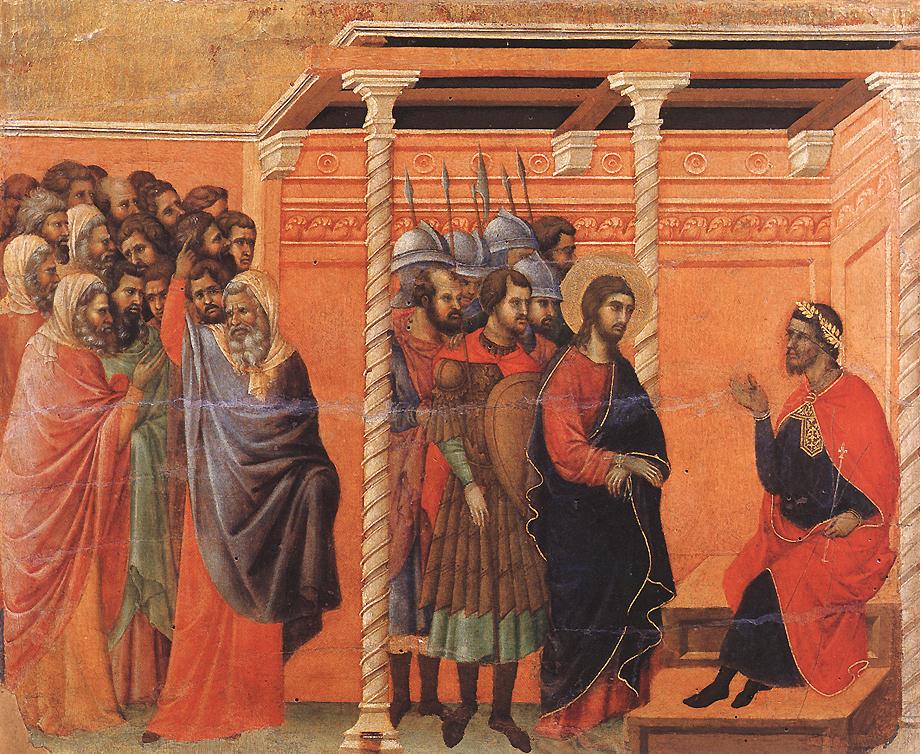
Pilate asked, “What is truth?” (John 18:38)

The question Pilate asked Jesus is one many have asked: What is truth?

The dictionary provides only a little understanding; many of its definitions of “truth” are tautological (“the state of being true”), but it provides us with a good starting place: the property of being in accord with fact or reality. We often understand “truth” according to its antonym “falsehood”: truth represents reality and fact, while falsehood presents some level of fiction, often with the motive to deceive in order to gain an advantage over the deceived.

Definitions and comparisons give voice to what we intuitively understand about truth even if we may find it challenging to explain it as such. Yet definitions do not help us answer the question about what is truth: what is fact versus what is fiction? What is real versus what is imaginary? And how can we have any confidence in our apprehension of what we believe to be true?

In the Western world, we are children of the Enlightenment, the Age of Reason, and positivist thinking. In the 18th and 19th centuries, Western people developed great confidence in our ability as humans to perceive that which is absolutely and objectively true and in our capacity to reason regarding what is true. Exaltation of knowledge and reason has led us very easily into the life of the mind and ideas, thinking about “truth” in terms of propositions which we formulate, analyze, dissect, dispute, and/or defend. Our ancestors maintained great confidence in not only the existence of absolute truth, that which is valid beyond any parameters or context, but also of our ability to come to a firm understanding of such truth or truths. Such exaltation of human reason, along with skepticism about any and all things metaphysical and supernatural, led many to believe certain absolute truth claims could be proven or verified: such is positivism. Even many who believed in God and affirmed the truth of God in Christ devoted themselves to such positivist rationalism and have made much of God as the Absolute Truth whose existence we can “prove” or “verify” based on the nature of the creation, and have made much of various propositions they affirm as “the truth.”

And then that world died in the cataclysms of the twentieth century. After the unimaginable horrors of two World Wars, the Great Depression, and the prospect of nuclear annihilation, it was hard to have a lot of confidence in human progress and reasoning. After millions of “civilized” people eagerly accepted demonic, inhuman propaganda and acted upon it, it was hard to have a lot of confidence in human ability to apprehend truth. When millions upon millions had died, and the prospect of nuclear winter seemed imminent, it was easy to fall into existentialist despair. Thus the Western world saw the rise of postmodernism and a return to Pilate’s question, bitter in despair: what is truth?

Pilate’s question to Jesus, of course, was less than sincere. Nothing in anything which has been preserved about Pontius Pilate would give us any reason to believe he was on a noble quest for what is true. Pilate was a man of the world, the dog-eat-dog rat race in which “truth” is only as good as it proves advantageous. Such is the world Machiavelli would well describe 1500 years later: it is better to be feared than loved. Ethics and morality are necessary for a society to function, but to obtain and maintain power one will have to breach them continually. Along the same line of thought, if you say something often enough, you can get people to believe it, and thus you can create and impose your own truth.

Our Enlightenment ancestors proved naïve and overly optimistic about human capacity for reason and ascertaining truth. We are finite, created beings: there is only so much we can perceive and understand. Our brain receives sense impressions from the world around us through our five senses; the abilities these senses provide are amazing and wonderful, but none of them are absolute. All of them involve active construction work by the brain. We cannot but miss seeing some things in our field of vision; some sounds our ears will sense but will be filtered out by the brain; we will not perceive some smells or tastes, and we cannot sense all things by touch. Furthermore, we can learn things about our environment, history, and the like, but we can never come to a full understanding of any of it. We will not have everything preserved; scientists continue to learn more about all kinds of things, even those things we think are basic to reality. Our memories are not static; according to the best evidence we presently have, in order to remember an event or experience our brains will recreate the event and have to re-archive it, and will almost invariably adapt and change that memory. We can never escape being “us”: pure objectivity is impossible. We have perceived or learned everything through the framework and prism of our own perspective, context, and background. We can never fully escape ourselves. And none of this even begins to speak of the corruption we have experienced on account of sin: our sense faculties and memory have been corrupted by sin and death, and we experience all kinds of motivated reasoning in how we perceive the world.

Thus many of the postmodern critiques of modernism remain quite valid. It was never a good idea for Christians to have been caught up so fully in the spell of Enlightenment rationalism and positivism. We have come to expect too much from humanity and have not been skeptical enough about our abilities. We did not take sophists and their sophistry seriously enough and naively maintained confidence that truth will prevail over error despite all the evidence throughout history to the contrary.

Yet is all lost? Is truth completely beyond us? What is truth?

What motivated Pilate’s question to Jesus?

Then Pilate said, “So you are a king!”
Jesus replied, “You say that I am a king. For this reason I was born, and for this reason I came into the world – to testify to the truth. Everyone who belongs to the truth listens to my voice” (John 18:37).

Jesus said He came to testify, or bear witness, to the truth, and those who belong to the truth listens to His voice. So what was this truth to which He bore witness? How can anyone belong to the truth?

Jesus replied, “I am the way, and the truth, and the life. No one comes to the Father except through me” (John 14:6).

What is the truth? Jesus is the Truth. The Word of God is truth (John 17:17); Jesus is the Word of God which took on flesh and dwelt among us (John 1:1, 14).

Then Jesus said to those Judeans who had believed him, “If you continue to follow my teaching, you are really my disciples and you will know the truth, and the truth will set you free” (John 8:31-32).

How could Israelites know “the truth” so that “the truth” would set them free? One can “know the truth” only like one can “belong to the truth”: one must believe in Jesus and come to know Jesus.

According to the Christian faith, therefore, Jesus is the Truth. Jesus came as God in the flesh, lived, suffered, died for our sins, and was raised on the third day in power by God, ascended, and now reigns as Lord. One day He will return to judge the living and the dead and all will be raised and transformed for eternal life or condemnation. We can communicate and speak of these truths as propositions, but their fact or reality is not in the proposition itself but in Jesus as ultimate Reality.

Jesus, therefore, is Truth. If the human category and conception of “absolute truth” has validity, “absolute truth” is God in Christ. God is our Creator, and He created us through His Word, and in His Word we have life, and that life is now manifest in Jesus (John 1:1-18. 1 John 1:1-4).

It has always been a fool’s errand for humans to imagine they could stake any substantive claim to capture the absolute, objective truth of anything. Our perception of reality is mediated by the senses and constructed by the brain; thus we can apprehend what is factual and real to some degree or another, but never fully absolutely. Even the most basic truth, like we exist, or Jesus is the Word of God made flesh and is the Truth, we can accept but never fully apprehend or understand. In our finite perspective there will be some things we will miss, however consciously or unconsciously; our perception and interpretation of reality do not absolutely, objectively reflect reality. If the standard to which we are held is full understanding, we will all fail miserably.

Thanks be to God, therefore, that the standard is not comprehension, but confidence. We are to maintain confidence in God in Christ through the Spirit and entrust ourselves to Him. As we seek to better understand the creation, we ought to do so not in order to manipulate and master but to better enjoy what God has made and glorify Him because of it. We can come to an understanding of what is true as we follow Jesus and become more like Him; the more we follow Him, the greater we are aware of the profound love of God displayed in Christ and how much greater God is than we are, and thus we learn greater humility and to hold our perceptions more lightly.

Jesus, therefore, is the Truth. We can come to a better understanding of all things when we understand them in and through Him. In Christ we are relieved of the burden of the expectation to come to full apprehension of truth as well beyond us and well entrusted in God our Creator. Let us therefore pursue Jesus the Truth and find eternal life in Him!

Ethan R. Longhenry

Witnesses | The Voice 13.35: August 27, 2023

posted in: The Voice | 0

The Voice

Witnesses

One witness shall not rise up against a man for any iniquity, or for any sin, in any sin that he sinneth: at the mouth of two witnesses, or at the mouth of three witnesses, shall a matter be established (Deuteronomy 19:15).

How can we know a thing is true? A matter can only be established by the mouth of two or three witnesses.

This principle is established in its most abstract in Deuteronomy 19:15: a charge of iniquity or sin could only be sustained by the mouth of two witnesses; in fact, any matter could only be established at the mouth of two or three witnesses. Previously this premise was established for capital crimes: no one was to be put to death on the basis of one witness alone, but only if there were two or three witnesses, and the witnesses were expected to begin the execution (Deuteronomy 17:6-7; cf. Hebrews 10:28). Joshua called upon the people to witness regarding themselves that they had chosen to serve YHWH (Joshua 24:22). Boaz calls upon the elders and people in the gate to serve as witnesses of his redemption of the house of Elimelech and taking Ruth the Moabitess as wife (Ruth 4:9-11). YHWH called upon Israel and His servant to be His witnesses to testify that He is God and there is no other (Isaiah 43:10-12, 44:8-9). Isaiah has a message certified by witnesses (Isaiah 8:1-2); Jeremiah’s redemption of a relative’s property is certified by witnesses (Jeremiah 32:10-12, 25, 44). Attesting all things by the mouth of two or three witnesses was manifestly an accepted part of Israelite legislation and life; its value was recognized even when Israel proved disobedient in many other ways.

The importance of two or three witnesses is not restricted to the old covenant; it is fully manifest in Jesus’ life, the proclamation of the Gospel, and in how Jesus and the Apostles expected Christians to adjudicate issues and disputes among them. Jesus appealed to the Law regarding witness and declared that both He and His Father testified to the truth of His judgment (John 8:12-18). Jesus’ intended second step in handling a brother or sister who sins against us is to take two or three with us so that every word is established (Matthew 18:16). At His trial the High Priest found no need of witnesses after they all heard Jesus speak “blasphemy” (Matthew 26:65, Mark 14:63). After His resurrection Jesus declared the Twelve to be witnesses to Him and what He had accomplished (Luke 24:48); note well how the Apostles, as they proclaim Jesus as the crucified and risen Lord, deliberately always evoke at least two witnesses, generally the prophetic word declared in the Law, Psalms, and the Prophets, and their own eyewitness testimony (e.g. Acts 2:22-36, 3:12-26, 13:16-41). A Christian’s confession was to be heard by witnesses (1 Timothy 6:12); the teachings regarding God in Christ were to be taught before many witnesses (2 Timothy 2:2). Accusations against elders were not to be heard unless certified by two or three witnesses, and Paul explicitly quotes Deuteronomy 19:15 to the Corinthian Christians as part of his warning before he came to visit them in judgment (2 Corinthians 13:1, 1 Timothy 5:19). Not for nothing, therefore, does God send down two witnesses to the earth in Revelation 11:3-13!

Establishing all things by two or three witnesses proves to be a pervasive and important theme in Scripture, but why? God made man, and God is aware of mankind’s limitations, frailty, and the corruption which has taken place since the fall (Romans 3:23, 5:12-21). Even in situations where a person has the most sincere of motives, one person may be convinced he or she saw something that did not actually take place. Whereas we may want to believe our senses and brains work like a database, accurately remembering sense perceptions, our brains prove more plastic: memories change to some degree or another as they are remembered. One person may be absolutely convinced what they feel or believe is true, even if in “objective reality” it is not. Beyond all this, what evidence or recourse does a person have if they are the only witness, and another contradicts that witness?

It is much harder to contradict a story told by two or three witnesses. Individual memory may be somewhat plastic, but if the testimony of two or three agrees, they most likely are attesting to what truly happened. One person may suffer from terrible motivations; it is harder to convince two or three people to share in that motivation. Furthermore, while one might easily dismiss the claims of one person as delusional, it proves much harder to claim that two or three (or more!) all suffer from delusion when they independently claim to have seen or participated in the same thing.

Is this standard foolproof? Very few things in life prove foolproof. Two or three people can collude and conspire against another. People even in Scripture are said to have borne false witness, and the ninth commandment is given for a reason (Exodus 20:16, Matthew 26:59-60). Throughout time there have no doubt been times when two or three witnesses bore false testimony and one person could testify accurately concerning what he or she saw.

Yet we do well to remember the reason for two or three witnesses: to establish a matter as true. One person may be accurate, but there is no faithful means by which to establish it on the basis of only one witness. We do well to establish this as the posture in our own lives.

How do we adjudicate claims of truth? What is true must be established by the witness of God in Christ: in the creation and through what has been spoken by God (John 14:6, Romans 1:19-21). If something cannot be established by these witnesses in Scripture and in what God has made, then it cannot be established as true. The Gospels provide four witnesses to Jesus’ life, death, and resurrection. The Apostles provided prophetic testimony as well as their own. We should be wary about any doctrine or practice for which there is but one proof text; by the mouth of two or three witnesses all truth should be established.

How do we handle claims of wrongdoing? Accusations should not be accepted, and judgments of sin rendered, on the basis of only one witness: this should be true in all relationships, with the one exception of sexual assault in open or private spaces, with the benefit of the doubt given to the one who was assaulted (cf. Deuteronomy 22:25-27). In intimate relationships it proves all too easy to confuse feelings for reality; merely because we feel does not mean someone has done wrong. Perhaps we misunderstood; perhaps we misread. If a matter in intimate relationships arises, Jesus provides the way forward: we are to speak directly to anyone whom we believe has sinned against us to win them back (Matthew 18:15). If the person refuses to hear us, we then take two or three with us to establish the truth of every word (Matthew 18:16): this does not mean that these people become witnesses of the original infraction but of how each party in the dispute handled themselves. If they will not hear then, it is to be taken to the church, and if they refuse to hear the church, it is no longer really about the original transgression, but the refusal to restore relationship and to be held accountable, and thus they are to be marginalized until they repent (Matthew 18:17). Two or three witnesses is of the greatest importance among the people of God, for not one of us has been given the right to stand as judge, jury, and executioner, and for good reason (James 4:11-12)! Accusations of unrepentant sin are very serious matters, and should be treated with the highest levels of integrity by the people of God: we must be above reproach on how we handle sin in our midst, and prove willing to purge leaven but only when leaven has been verifiably identified.

We do well, therefore, to establish “by the mouth of two or three witnesses let a matter be established” as a mantra for our lives. God in Christ has provided two witnesses. The Apostles provided two witnesses. We should learn to seek two or three witnesses to establish the validity of a thing, and never presume the right to serve as judge, jury, and executioner for anyone in any relationship. May we glorify God in our lives and ground our faith in God in Christ!

Ethan R. Longhenry

Living Dogs and Dead Lions | The Voice 13.34: August 20, 2023

posted in: The Voice | 0

The Voice

Living Dogs and Dead Lions

So I reflected on all this, attempting to clear it all up. I concluded that the righteous and the wise, as well as their works, are in the hand of God; whether a person will be loved or hated – no one knows what lies ahead.
Everyone shares the same fate – the righteous and the wicked, the good and the bad, the ceremonially clean and unclean, those who offer sacrifices and those who do not. What happens to the good person, also happens to the sinner; what happens to those who make vows, also happens to those who are afraid to make vows. This is the unfortunate fact about everything that happens on earth: the same fate awaits everyone. In addition to this, the hearts of all people are full of evil, and there is folly in their hearts during their lives – then they die.
But whoever is among the living has hope; a live dog is better than a dead lion. For the living know that they will die, but the dead do not know anything; they have no further reward – and even the memory of them disappears. What they loved, as well as what they hated and envied, perished long ago, and they no longer have a part in anything that happens on earth.

Go, eat your food with joy, and drink your wine with a happy heart, because God has already approved your works. Let your clothes always be white, and do not spare precious ointment on your head. Enjoy life with your beloved wife during all the days of your fleeting life that God has given you on earth during all your fleeting days; for that is your reward in life and in your burdensome work on earth. Whatever you find to do with your hands, do it with all your might, because there is neither work nor planning nor knowledge nor wisdom in the grave, the place where you will eventually go (Ecclesiastes 9:1-10).

We are all going to die. So how should we live?

Throughout Ecclesiastes 1:1-6:12 the Preacher meditated upon the hevel of life under the sun: all is vain, futile – truly absurd. He compares most human endeavors toward meaning as “chasing after wind”: people pursue pleasure, wealth, wisdom, or other things looking for ultimate purpose and satisfaction and will be disappointed and frustrated by all of them. To rage against such truths is itself futile and striving after wind. God understands better than we do. In Ecclesiastes 7:1-8:9 the Preacher seemed to have set forth a series of aphoristic exhortations not unlike the proverbs for which he is well known loosely organized around the theme of wisdom. In Ecclesiastes 8:1-17 the Preacher would continue in the same aphoristic vein and loosely organized his exhortations around wisdom in terms of the exercise of and submission to power and observations about life but the ultimate limitations and failures of knowledge and wisdom.

We always do well to remember how chapter and verse divisions were added to the text at a far later period; even when they prove helpful for reference purposes, we should hold them lightly. In this way the Preacher’s observations in Ecclesiastes 9:1-6 flow directly from Ecclesiastes 8:14-17. Just as no human can truly comprehend what happens on the earth (Ecclesiastes 8:16-17), so humans also do not know their future (Ecclesiastes 9:1): their works are in God’s hands, whether wise or wicked, and whether they will experience love or hostility. While the Preacher has been confessing all he did not and could not know, he then returned to one of the things which he did know, and the reality which seemingly has informed and undergirded much of his fulminations: everyone dies. A person who is good and righteous, clean, and offers sacrifice? He or she dies. A person who is bad and wicked, unclean, and does not offer sacrifice? He or she dies. A person can make a thousand vows or be afraid to make any vowels at all: either way, they die (Ecclesiastes 9:2). Furthermore, since all are subject to corruption and decay (cf. Romans 5:12-21, 8:17-23), the human heart is full of evil and folly, and then they all die (Ecclesiastes 9:3).

The Preacher has rightly observed the condition of humanity “under the sun.” The universality of death has no doubt animated the Preacher’s sense of existential despair: everything is hevel, breath or vanity, because human life ultimately is but a breath or vanity. You can be the best and wisest person; in your wisdom you might delay the inevitable, but death will still come for you. Humans have been morally outraged for generations when people who have tried their best and have done well have died young and/or in poverty while many others who were wicked and depraved yet lived for quite some time in relative wealth. We all rail against the coming night; we all attempt to find something in which to invest our hope of life beyond this life, whether by building monuments, investing our time and energy in some kind of institution or power, through our influence on others, and/or through perpetuating our genetic line. No matter; we will all die regardless, and most of us will be all but forgotten within a few generations. We do everything we can to deny or suppress this bitter truth. The Preacher has been devastating all such pretense and ignorance and forces his audience to see their condition plainly.

Yet the Preacher can find a glimmer of hope in the situation of the living: they are alive and are conscious. He declared a live dog is better than a dead lion (Ecclesiastes 9:4): the lion has always been a symbol of power and elevated status, while dogs in the ancient world did not share in much esteem at all. Yet the live dog, even in his degraded status, is better than the dead lion; perhaps once majestic, but now a mere corpse rotting in the sun, picked over by scavengers. Thus the Preacher reckoned the living as in a better condition than the dead: the living have knowledge, while the dead know nothing, have no reward, have generally been forgotten, everything regarding which they cared has perished, and they have no active role in the existing creation (Ecclesiastes 9:5-6).

We do best to understand Ecclesiastes 9:5-6 in its own time and place and, as with Ecclesiastes 9:7-10, as encouragement for the living to enjoy life as long as they have it, and not succumb to existential despair. We have no reason to doubt or question the Preacher’s sincerity in his viewpoint regarding the finality of human death; the Psalter at times expresses a similar view of oblivion in Sheol (cf. Psalm 6:5). Oblivion might well be the fate of many souls on the final day, and it may end up being a grace for them. Many scholars understand the Preacher to represent a school of thought very much opposed to the developing confidence of many in Israel regarding life in the afterlife and the hope of resurrection. Yet we can also understand all such things in terms of progressive revelation: the focus of the covenant between God and Israel involved this earthly life, and the importance of life after death would become a far greater part of the life of Israel in the Second Temple Period and fully embodied in Jesus. At the very least, the Preacher’s observations about death stand at variance with Jesus’ solemn exhortation of God being the God of the living, not the dead, and explicitly in terms of Abraham, Isaac, and Jacob (cf. Matthew 22:31-32). We should also be able to appreciate the dangers of decontextualized proof-texting from this experience: the Preacher spoke based on his understanding and in terms of the understanding of his audience, and while he saw rightly in terms of life “under the sun,” God understands more than he did, as he himself confessed, and no doubt the Preacher himself has come to know the power of God over sin and death in Jesus.

In the face of imminent death and oblivion, what should people do? The Preacher unironically counsels to “eat, drink, and be merry” (cf. 1 Corinthians 15:32): people should enjoy their food and wine, of which God has approved; they should wear clean clothes and anoint themselves, and thus enjoy the little pamperings of life; a man should enjoy his conjugal relationship with his wife, for such is what God has given people to enjoy in their fleeting lives; and whatever they do for work they should do diligently, for there is no energy or work where they are going (Ecclesiastes 9:7-10).

Thus the Preacher again reinforces the core of his exhortation: everyone dies. Everything you hold dear in this creation will fade just like you fade. You cannot build up for yourself any kind of immortality on the earth. Our great frustration and our railing against these realities expresses the profound levels of delusion we maintain about our grandeur. The Preacher does not thus diminish the power or value of life; instead, he enhances it by reminding people of what they do have and what they can enjoy. The things we often consider the “little things” — enjoying a great meal with family and friends, enjoying romance and sexuality, working in ways we find meaningful and expending our energy in ways we find profitable — these are what make life worth living, and we should find some level of enjoyment in them. Wasting away our hours and years to construct a future which will never come and/or investing in schemes for immortality which will themselves fade away would prove to be the real tragedies. Harry Chapin’s “Cat’s in the Cradle” hits hard for this very reason. We say “no one on their deathbed wishes they had spent more time in the office” for good reason. Thus the Preacher has said his own version of these things; we can find similar thoughts in the Epic of Gilgamesh which is one of the earliest pieces of literature and wisdom ever recorded. None of this is new. And yet each successive generation still rails against the coming darkness and vainly attempts to invest their hopes of immortality in things which will ultimately perish. We are all Sisyphus; our quest for meaning in life “under the sun” is our heavy rock. We all know better, and yet we struggle to do better.

We consider 1 Corinthians 15:32 in order to demonstrate the tension Ecclesiastes 9:5-10 provides for the Christian, since the Preacher essentially commends an epicurean lifestyle. Not for nothing has our modern secular consensus ended up settling on a form of Epicureanism, because whenever you have limited your perspective to the material plane of existence, and create little if any space for the work of the divine, what else is really left as a viable philosophy of life? Do what you can to avoid pain; pursue what you find pleasurable in ways which cause the least amount of harm. The Preacher remains undefeated: there truly is nothing new under the sun, and what we deem new or modern is most likely something recycled from the past.

Paul wrote as he did in 1 Corinthians 15:32 because if there is no resurrection from the dead, then the Preacher and the Epicureans are absolutely correct. Yet Paul had seen Jesus in the resurrection, the firstfruits of the dead; and since Jesus is risen, Paul maintained great confidence He would return and all who share in Jesus would also share in the resurrection of life (1 Corinthians 15:1-58). Jesus is the most powerful testimony of how God is the God of the living, not the dead.

As Christians we should enjoy food and drink, giving thanks to the God who has given it and blessed it (1 Timothy 4:4-5). Christians who have been joined together by God in marriage should enjoy their romantic and conjugal relationship which is to be held in honor among everyone (1 Corinthians 7:1-4, Hebrews 13:4). During this life Christians should work diligently in order to provide for themselves, to have something for those in need, and to facilitate quiet and godly lives (1 Thessalonians 4:10-12, 2 Thessalonians 3:6-15, 1 Timothy 5:8). We do well to heed the wisdom of the Preacher, which is itself wisdom understood by humans in almost every age and time: you cannot take it with you; your pretensions for immortality on this earth are delusional; a life entirely lived for a future which will never arrive is the ultimate tragedy. Yet we do not lose hope, for our hope was never supposed to be in this life alone. God is the God of the living, not the dead; in Christ our future is not oblivion, but incorruptibility and immortality in the resurrection, and a new heavens and earth which will never fade or decay. May we serve God in Christ through the Spirit and obtain this resurrection of life!

Ethan R. Longhenry

Mystery of the Gospel | The Voice 13.33: August 13, 2023

posted in: The Voice | 0

The Voice

The Mystery of the Gospel

Paul did well at encouraging his fellow Christians with reminders of all the spiritual blessings with which God has blessed them in Christ, praying they might be able to understand the greatness of the salvation they obtained in Christ, the head of the church (Ephesians 1:1-23). Paul explained the nature of that salvation, how all had sinned and yet God showed love, grace, and mercy through Jesus to provide a means of salvation so Christians could be full of good works (Ephesians 2:1-10). Paul made it known how this salvation was offered to Gentiles, those of the nations: the hostility which had existed between the people of God and the nations was killed by Jesus on the cross, and He can now make all into one man in one body (Ephesians 2:11-18). Anyone can now be a fellow-citizen of the household of God and become part of the holy temple of God in the Spirit (Ephesians 2:19-22).

On account of these great blessings and salvation, Paul would again pray on behalf of his fellow Christians, but not until he explained the mystery of the Gospel regarding which he had already made many allusions (Ephesians 3:1-13). Paul envisioned his current imprisonment as a benefit for the Christians to whom he wrote, for it is to their glory (Ephesians 3:1, 13); he is imprisoned for his work in proclaiming among the Gentiles the mystery which God revealed to him, something not made known to previous generations of God’s people but now manifested in what God has accomplished in Jesus (Ephesians 3:1-5). It is easy to think of “mystery” in terms of either a “whodunit,” a crime story in which a sleuth uses all the clues to ascertain and indict the criminal, or something vague, unknown, and unknowable, yet Paul came out with a full explanation of this mystery: Gentiles can be fellow heirs, fellow members, and fellow partakers in the body and promises of Christ (Ephesians 3:6). It is not as if this mystery came without any warning or previous information: all of what Jesus accomplished had been prophesied in the Law, the Writings, and the Prophets (Luke 24:44). Yet the hand of God is evident in the story of Jesus, for while all He did was prophesied, people would not of their own invention or volition put the story together the way in which it came to pass in Christ. Thus the mystery of the Gospel was unveiled in the work which God accomplished in Jesus and communicated by the Spirit (Ephesians 3:1-6)!

Paul proclaimed the Gospel among the Gentiles by the commission of God in Christ who saved him despite his unworthiness, having been a persecutor of the church (Ephesians 3:7-8; cf. 1 Timothy 1:12-16). God hid this mystery prepared before the beginning of the world until the time of Christ, and now not only can all men hear and see it, but the manifold wisdom of God as manifest in the church is displayed to all the powers and principalities of heaven (Ephesians 3:9-10). The wisdom of God manifest in the church was the eternal purpose He established in Christ, through whom we now have boldness and access in faith to God (Ephesians 3:11-12). An eternal purpose continues perpetually in at least one direction; therefore, God’s purposes in Christ remain as active today as they did when the Lord Jesus arose and the Apostles walked the earth. Furthermore, Paul established the high level of importance God places on the church: it is no mere accident, “Plan B,” or holding pattern, but the ultimate realization of His wisdom. The church represents many groups of people who otherwise would be at odds with each other but have become one body in Jesus, and that is a powerful testimony to the working of God in Christ to all the powers and principalities which have worked to keep mankind divided. Thanks to Jesus we can have boldness before God in access in faith; we do not deserve any standing before God because of what we have done, but Jesus’ sacrifice cleanses us and allows us to stand before God and make our requests known.

Paul then got around to making the prayer which he planned on making: that God would strengthen the Christians with power through His Spirit in their souls to comprehend the love of Christ which is beyond knowledge, having been filled with Christ and the fullness of God and rooted and grounded in love (Ephesians 3:14-19). Paul praised God as the One able to do beyond what Christians could ask or think according to the power at work within them, seeking that He might be glorified in Christ and the church for eternity (Ephesians 3:20-21). This prayer may seem confusing: how can Christians come to any kind of understanding of something that surpasses knowledge? This is precisely Paul’s point; he wished for Christians to realize the vastness of God’s love for us in Christ and to be continually humbled by and thankful for it. Paul also invited Christians to consider the greatness of that power of God: He is able to do anything beyond our imagination, and does so by the power at work within us, but only if we ask. Do we ask to obtain that power from God to accomplish His purposes? Do we limit what God is able to do through us because of a lack of imagination or willingness to ask for mighty things to be accomplished? Do we truly believe that God is as willing to do such things as we profess confidence in His ability to do so?

Paul thus laid out the mystery of God in Christ: Jesus lived, died, and was raised again in power, and now serves as Lord. All have sinned but can find salvation in Jesus; in Jesus can be found spiritual blessings beyond imagination, and God is at work advancing His purposes in Jesus and the church in full display before the powers and principalities in the heavenly places. May we submit to the Lord Jesus Christ and trust in God and His power to accomplish great things through us to His glory and honor!

Ethan R. Longhenry

Bias | The Voice 13.32: August 06, 2023

posted in: The Voice | 0

The Voice

Bias

Jesus said, “For judgment I have come into this world, so that those who do not see may gain their sight, and the ones who see may become blind.”
Some of the Pharisees who were with him heard this and asked him, “We are not blind too, are we?”
Jesus replied, “If you were blind, you would not be guilty of sin, but now because you claim that you can see, your guilt remains” (John 9:39-41).

Have you ever noticed the “new car” phenomenon? If you purchase a car of a new make or model, all of a sudden, you start noticing a lot more of that make and/or model on the road.

Have you heard of the “gorilla suit” study? People were invited to participate in a study in which they were told to focus on a particular activity going on in a video. During that video a person in a gorilla suit would appear. When asked if they saw anyone in a gorilla suit, a not insignificant percentage of people said “no.”

Likewise, have you recently wondered if you have become a prophet or a son of a prophet because you seem eerily able to predict exactly how people are going to respond to a given piece of news or a new finding based on their political or philosophical perspectives?

In all of these examples, cognitive bias is in play.

A significant part of the development of critical thinking involves awareness of bias. Bias is generally reckoned as a form of distortion or prejudice, and is itself often brought up with extreme prejudice: an inclination, for a host of reasons, to favor a given idea, group, or stance against another in a way perceived to be unfair. We have all become quite familiar with confirmation bias: the impulse to receive and interpret all data in ways which confirm our prior beliefs and perceptions, and great resistance and skepticism toward any data which would undermine those beliefs. Attribution error and implicit bias involve judging behaviors based on perceived personality traits and subconscious prejudicial judgment of an individual based on perceived group association, respectively. Our predilection to favor people “like us” is affinity bias; our great confidence in ourselves and our judgments is the overconfidence or “Dunning-Kruger” effect. Our desire to continue to do things as we always have, and concern about or resistance against change, is the status quo effect. It is easy for people to believe people who are aesthetically attractive must have other attractive characteristics, and for us to believe people who have been highly successful in one field will be successful in others. We prove far more willing to take credit for the things we have done well and to downplay or suppress all things in which we have not done as well. We are convinced we had well predicted what would happen. For that matter, our judgments about a given situation often prove dependent on our physical condition: for good reason we say that we are not ourselves when we are hungry. Bias thus manifests itself in manifold ways.

Bias remains antithetical to the endeavor to obtain “objective” information and understanding regarding the world around us. We can well understand why many prove very hostile to bias if their desire is to develop a transcendent perspective which purports to overcome all personal prejudices.

This aspiration to objectivity is a major hallmark of Enlightenment rationalism. While we might be able to appreciate the goal of objectivity, and commend attempts to grapple with one’s own prejudices and limitations in perspective, the time is well past to presume any human being can truly become objective in their perspective. Enlightenment rationalism was founded on overly optimistic assumptions regarding human capacity which never sat well with Scripture and now stands at variance with scientific discoveries regarding cognition.

According to the witness of Scripture God made human beings as part of the creation, finite with broad but not unlimited understanding (Genesis 1:1-2:3). Humans have always been “contextual” creatures, living in particular times and places and formed by those times and places more than forming them. God’s thoughts and ways have always been higher than man’s (Isaiah 55:8-9); if there is any hope for “pure objectivity,” it will only be manifest on the divine level. Humans are not merely created and finite; they have also been corrupted in their fallenness: the ways we think, feel, and act are subject to corruption and futility on account of sin and death (Romans 5:12-21, 8:17-23). Anxiety and fear prove as powerful as motivators for how we understand things as any noble quest for truth.

Science has also cast aspersions on many of the assumptions we have maintained about our ability to perceive our environment. Everything we perceive through our five senses are, to some degree or another, constructed by our brains. The brain’s ability to take in the electrical impulses generated by the sense organs and construct what we see, hear, etc., is amazing, astonishing, and should compel us to give glory to God our Creator; at the same time, the brain is both filtering out a lot of data and interpreting a lot of data lest it, and we, get overwhelmed.

Both the “new car” phenomenon and the “gorilla suit” study exemplify for us, and explain, the situation in which we find ourselves. Our brains are not mere “objective” data processors; in order to be able to focus on certain details we deem important at any given moment, the brain by necessity must de-emphasize, or functionally ignore, many other details. While it remains possible that a given car make and/or model truly has become more popular and thus more visible over time, it is more likely that there have always been plenty of those car makes and/or models driving around; the brain had no particular reason to notice, and so it, and we, did not. It is beyond a doubt that the images of a person in a gorilla suit were processed by the eye and brain; but in pursuing the task to focus on a given activity, the brain filtered out that data which proved extraneous to the task at hand, and thus plenty of people did not “notice” the person in the gorilla suit.

What proves true regarding perception also proves true regarding cognition. Just like our brains interpret sensory data to construct our perception of our environment, so we interpret how we understand ourselves and our world by means of the ideological framework(s) we have built and cultivated over time. These frameworks prove necessary for our sanity: we do not have the brain processing capacity, let alone the time, to take each piece of data we receive, examine it thoroughly and objectively, and adjust our frameworks accordingly. Just like the brain takes in data and filters out what it deems less important or relevant so as to focus on or highlight what it deems more important and relevant, so we likewise privilege certain forms of information and comparatively ignore or dismiss other forms of information.

Ironically, therefore, our bias against bias is unhelpfully overly prejudicial. Bias is not some aberration based on the naivete of the simple masses; instead, bias is built into the way we receive input from our environment and how we process the information we receive. Since we will continually remain human, and thus subject to the limitations and frailty common to humanity, we will never be able to escape bias.

Any attempt to fully overcome bias, therefore, proves a fool’s errand. We cannot stop being human; none of us have God-level perspective on anything. Yet such does not mean we should fall into some kind of existential despair. The Lord Jesus Christ knows what mankind is and has given us a way forward.

In John 9:39-41 John concluded the story of Jesus healing a man born blind. The Pharisees wonder if they are blind. Jesus told them they would be without guilt if they were blind; because they said they saw, their sin remained. Likewise, in warning people about judgment in Matthew 7:1-4, Jesus encouraged people to see themselves as having beams in their eye while seeing specks in the eyes of others. Only a hypocrite could point out the speck without noticing the beam; Jesus counseled people to first remove the beam from their own eye before they could take out the specks in the eyes of others.

Both exhortations direct us to proper humility. We are very cognizant of the way others express bias; yet how often do we prove willing to come to grips with our own? We find no lack of people willing to baptize and justify their biases and prejudices by presuming the way they understand things to be the way God understands things, as the “Biblical” way of understanding things, and the like. We get into the most trouble when we dogmatically insist on our perspective as the correct one, presuming that we truly see, yet according to the perspective of God in Christ, prove truly blind.

It is good to aspire to have one’s viewpoints shaped by what God has made known in Christ and to resist the seductive ways of the philosophies of this world (cf. Colossians 2:1-10). We do well to grow in the grace and knowledge of our Lord Jesus Christ, who is the Way, the Truth, and the Life (John 14:6, 2 Peter 3:18). At the same time, we remain human and our perspectives remain limited and thus biased. We will not be able to fully overcome that bias; the best we can do is to consider different perspectives so as to become more aware of our biases, and to hold more lightly onto our ideologies, perspectives, and viewpoints since they all do reflect biases in many ways. We should show charity toward those with whom we disagree and prove willing to submit the ideas of those with whom we feel we have affinity to as great, if not even greater, scrutiny as those with whom we feel we do not have affinity.

Human beings, therefore, cannot escape bias. The best we can do is recognize it and prove less dogmatic in our confidence in our frameworks and perception. May we prove humble, confessing our limitations in perspective and understanding, and thus prove willing to hold our judgments lightly so that we might be found faithful to God in Christ through the Spirit!

Ethan R. Longhenry

Greece | The Voice 13.31: July 30, 2023

posted in: The Voice | 0

The Voice

Greece

It is a heavily mountainous, rocky outpost, on the extreme southeast of what would become Europe. It existed on the periphery of the known world of the ancient Near East. No one in the world of the Bronze Age would have expected it to have ever amounted to much especially after its existing palatial civilization collapsed. Yet out of the long-term reckoning of that collapse would come new forms of government and ways of exploring and viewing the world. However one wishes to conceive of “Western civilization,” it certainly found its origins in Greece.

Greece (Hellas in Greek) sits at the southern end of the Balkan Peninsula as it juts out into the Mediterranean Sea. The modern nation of Greece extends over the historic territory of Hellas along with areas of ancient Macedon and Thrace; in the ancient world the land of Greece was reckoned the peninsula of the Peloponnesus and mainland Central, or Continental, Greece, with Epirus and Thessaly representing its northern border, along with the constellation of islands which filled the Aegean Sea to the east, Ionian Sea to the west, and the Mediterranean Sea to the south. Most of the land of Greece is quite rugged; only within the past century have many of its towns and cities been connected by overland routes. Most association and trade among Greek towns took place by sea, and the geography well explains the ancient Greek penchant for many city-states (polis in Greek): sometimes at war, sometimes in alliances, but always in competition.

In Genesis 10:2-5 the Genesis author spoke of Japheth as a son of Noah who himself had a son named Javan among whose children were Elishah, the Kittim, and the Dodanim, who would populate “the coastlands”; Japheth is Iapetos in Greek and is reckoned as the ancestor of the Greeks; Javan is associated with the Ionians of western Asia Minor and Greece; Elishah with Cypriots; the Kittim with southeastern Asia Minor (and in later writings, the Romans), and Dodona was an ancient and well honored location in ancient Greece (and “Danaan” was one of the terms the most ancient Greeks used to speak of themselves). The Biblical record well accords with DNA evidence suggesting the islands and mainland of Greece were populated by people from Anatolia. Throughout the Hebrew Bible the “coastlands” and “islands” would be used to speak of lands controlled or heavily influenced by the Greeks.

The earliest flowering of civilization in Greece, and all of Europe, centered on Crete and the Cycladic islands of the Aegean Sea which we now speak of as the Minoan civilization (ca. 3200-1450 BCE). Minoan art and trade goods can be found throughout the Aegean, the Levant, and Egypt, and strongly influenced its successors, which we deem the Mycenaeans (ca. 1750-1050 BCE). The Mycenaean was a palatial civilization based in mainland Greece, with Mycenae as perhaps the strongest and most representative city-state. The Mycenaeans built well-fortified cities with what would be later deemed “cyclopean” walls, wrote in proto-Greek in what is called Linear B, and were active in trading and warfare among the various city-states which comprised the Mycenaean world along with the western coast of Asia Minor. Yet in most respects the Mycenaeans modeled themselves after the Bronze Age civilizations of the ancient Near East, maintaining a very top-heavy hierarchy centering on the palace and gifts and trading with other palaces.

Yet everything would change for Greece between 1250 and 1050 BCE: the Mycenaean, and in fact the entire Bronze Age ancient Near Eastern, system collapsed. Cities and palaces were destroyed or ultimately abandoned, as was writing and the Linear B script. Ramses III of Egypt, in the days of the judges of Israel (ca. 1150 BCE), testified to the ravages of the “Sea Peoples” whom he claimed destroyed cities and civilizations around the Mediterranean and who had invaded Egypt itself; while the “Sea Peoples” may have included many other people, it certainly featured many Mycenaean Greeks. After defeating the “Sea Peoples” Ramses III settled some of them, the Peleset, in the southwestern Levant; they would become the Philistines of whom Amos would declare originated from Caphtor, likely Crete (Amos 9:7).

From this period until ca. 776 BCE, the days of the judges, united monarchy, and the beginning of the divided monarchy in Israel, Greece experienced what had frequently been called its “Dark Age”; modern scholars prefer the less judgmental “Early Iron Age”. The population of Greece was halved by this time; later Greeks would claim an invasion of the Dorians, a Greek speaking people from the north, also took place during this time. The palatial administrative structure had completely collapsed and fallen, and quite notably, no one attempted to replace it. We have very little information about this period, which is why many referred to it as a “dark age”; while the characters and many of the details of the Iliad and the Odyssey are Mycenaean, many believe the social imaginary of these epic stories better reflects the Greek Early Iron Age. The ancient Greeks would always look back to the time of the Mycenaeans as a lost “golden age” and prized the Iliad and the Odyssey like we do the Bible. And yet what they would develop barely resembles the world of the Mycenaeans.

The period from 776 BCE until the defeat of Xerxes and the invading Persians in 480 BCE, the rest of the divided monarchy, the exile, and the early days of the Second Temple Period in Israel, is known as Archaic Greece. Everything which would reach its full flowering in the Classical period found its origins in Archaic Greece. Greece experienced a population explosion in the 8th century BCE which led to the consolidation of the smaller villages and kinship groups of the Early Iron Age into the poleis, or cities, developed as such for the first time, and also Greek colonies would again form on the Ionian coast of Asia Minor and throughout what would become Magna Graecia, “Great Greece,” in the southern half of Italy and on Sicily. Beginning this period with the first Olympic Games in 776 BCE is appropriate: representatives of the Greek poleis would convene and compete in various athletic contests, with great glory and honor bestowed upon the victors. Thus the elite among the various Greek cities cultivated and fostered this competitive spirit which also led to many other artistic, cultural, and military innovations. At some point in the ninth or eighth century BCE, a single individual (it would seem) developed a version of the Phoenician alphabet modified to reflect the Greek language which we now know as the Greek alphabetic script (which the Romans would modify to become the Latin script we use to this day), and according to some scholars, not primarily to record economic activity but in order to preserve the epic cycles we know as the Iliad and the Odyssey. The different cities were all Greek in language, religion, and character, yet developed different forms of governance: in the late Archaic period the democracy of Athens was prepared by the laws of Solon and the work of Cleisthenes, and the Spartans, having defeated and enslaved the neighboring Messenians and reducing them to “helots,” fine-tuned a highly disciplined militaristic society, and many other Greek city-states vacillated among tyrannies, oligarchies, and other forms of governance. During the Archaic period some Greeks devoted themselves to exploring the world around them and through such investigation attempted to explain how everything came to be and how everything should work: this quest for wisdom and understanding would be called philosophy, the pre-Socratic philosophers all date to the Archaic period, and Pythagoras advanced the study of mathematics and music. Archaic Greeks also developed new military strategies centered on what would be known as the phalanx, armed infantry formed in close rank and files, and they would soon be tested in a significant way.

From its inception the Persian Empire had maintained a significant presence in western Asia Minor. Since the Greek colonies on the coast of Asia Minor constantly instigated rebellions against the Persian authority, Darius I sent an invading force to conquer Greece in 490 BCE. Such began the Persian Wars, and on paper, it should not have been a contest: the Persian Empire was the largest the world had ever seen, with all the nations of the ancient Near East at their disposal, and the naval fleets of the Egyptians and Phoenicians; the Greeks, even at their most unified, were far smaller. And yet the Athenians and their allies defeated Darius’ forces at Marathon. A decade later, Darius’ son Xerxes (the Ahasuerus of Esther) vowed revenge against the Greeks and personally led an impossibly large army and navy against Greece. The Greeks would suffer defeat at Thermopylae and Athens would be burned; yet the Greeks completely smashed the Egyptian and Phoenician navies at the Battle of Salamis, and Xerxes’ land army would be decisively defeated the next year at Plataea. Against all odds the Greeks preserved their freedom from Persian domination; otherwise what we deem the origins of Western civilization would have been snuffed out before they could be well established.

The defeat of the Persians inaugurated what we now call the Classical period of ancient Greece, lasting around 150 years until 340 BCE. During the Classical period the Greeks rebuilt Athens with its Parthenon and many other marvels which we can see to this very day. The Classical period was the age of Socrates, Plato, and Aristotle, philosophers of metaphysics and the natural world whose teachings and questions continue to drive philosophy and how we understand the world to this day. The Classical period also saw the flowering of Greek theater with the comedies of Aristophanes and the tragedies of Aeschylus, Sophocles, and Euripides, often using the characters and stories of the Mycenaean heroic age to explore and sit in the challenges and difficulties of the present world, and studied and presented to this very day. Herodotus, the “father of history,” explored the known world and wrote his discoveries down in his Histories, which remains a primary source for a lot of ancient Near Eastern history and the Persian Wars.

During the Classical period Athens remained a democracy but cultivated and developed a maritime empire around the Mediterranean and Black Seas. They were resisted by the Spartans and the Peloponnesian League, leading to the Peloponnesian Wars (431-404 BCE), chronicled in a rigorous historical exposition by Thucydides. The Spartans ultimately defeated the Athenians but would lose hegemony over Greece to the Theban Boeotian Confederacy in the early 4th century BCE. Between the Persian Wars and Philip II of Macedon, the Greek world thus featured the rise and fall of coalitions centered around Athens, Sparta, and Thebes, and always with intrigue stemming from the involvement of the Persian court.

The Classical period featured the flowering of all sorts of intellectual, philosophical, and technological advancement rarely surpassed in human history. Yet the Greeks could never find unity among themselves. The Classical period would meet its end at the hands of those whom the Greeks would have considered backwater half-barbarians, the Macedonians to their north, who under Philip II defeated the Greek coalition at Chaeronea in 338 BCE and thus conquered Greece. His son Alexander, tutored by Aristotle himself, finished what his father started, exerted authority over all of Greece, and then set out and conquered the Persian Empire, and thus the whole ancient Near Eastern world, and even reached the Indus of India by 323 BCE.

From 323 until 146 BCE the Greeks experienced the Hellenistic Age. The Greeks may not have had much military power at this time, but their cultural and intellectual influence was rapidly transforming the world around them by means of the Macedonian empires throughout the Near East. Many Greeks decamped for the cities of these empires to the east or the Italy in the west.

Rome’s influence in Greece would grow throughout the second century BCE, culminating in the Battle of Corinth in 146 BCE, in which Corinth was completely destroyed, and all Greece would be absorbed by Rome into its Empire by 27 BCE. The Roman period in Greece would technically not end until 1453 CE and the fall of Constantinople. The Romans organized most of historic ancient Greece into the province of Achaea, and some of its northern areas were made part of Macedonia. During this time Greece would have no political power whatsoever beyond the local level; but in a very real way the Greeks would “conquer” the Romans in terms of intellect and culture. Roman elites highly valued well-studied Greeks as the tutors of their children, and such is why we speak rightly of Classical and Late Antiquity as “Greco-Roman.” Koine Greek remained the lingua franca of the eastern Mediterranean world; in the early part of the Roman period Paul would visit Greek cities such as Philippi, Thessalonica, Berea, Athens, and Corinth, and established churches there. Over time the Greeks would come to see themselves as Romans, and in the days of the “Eastern Roman Empire” (or “Byzantine Empire”), the people of Greece identified as Romans (ca. 350-1450 CE).

The prophet Joel chastised the Phoenicians and Philistines for capturing Judahites and selling them into slavery to the Greeks (cf. Joel 3:4-6). In the days of the Maccabees, the Israelites appealed to the Spartans and entered into a league of friendship with them (ca. 145 BCE; cf. 1 Maccabees 12:20-30). We otherwise do not see many direct connections made between the Israelites and the Greeks proper before the days of Jesus. And yet it would be the Greek culture into which the Seleucids would compel the Jewish people to assimilate; the Hebrew Bible would be translated into Greek to become the Septuagint; Koine Greek was spoken throughout Israel in the Second Temple Period. The Gospel would come to Greece; while the Greeks would become Orthodox Christian, the prevalence of Greek-speaking and Greek philosophically instructed Christians would lead the story of what God accomplished in Christ to take on much of the scaffolding afforded by the Greek philosophical systems. The New Testament was communicated first and foremost, after all, in Koine Greek. The medieval world in the West was profoundly shaped by the synthesis of the Christian religion and Greek literature, mathematics, and philosophy, and in truth all philosophical theories to this day, in some way or another, represent a re-hashing of the various philosophical schools and ways of thought manifest in ancient Greece.

Thus Greece became the cradle of Western civilization; its religion and philosophy would dominate the ancient world; Judaism and Christianity would both be significantly defined by their engagement with, absorption of, and resistance to the thought world of the Greeks. We can marvel at and appreciate the contributions of the Greeks while also being on guard lest we are beguiled and captured by such philosophies (cf. Colossians 2:8). In all things may we submit to God in Christ through the Spirit and obtain the resurrection of life!

Ethan R. Longhenry