

Psalm 151
This psalm is ascribed to David as his own composition (though it is outside the number), after he had fought in single combat with Goliath.
I was small among my brothers, and the youngest in my father’s house; I tended my father’s sheep.
My hands made a harp; my fingers fashioned a lyre.
And who will tell my Lord? The Lord himself; it is he who hears.
It was he who sent his messenger and took me from my father’s sheep, and anointed me with his anointing oil.
My brothers were handsome and tall, but the Lord was not pleased with them.
I went out to meet the Philistine, and he cursed me by his idols.
But I drew his own sword; I beheaded him, and took away disgrace from the people of Israel (Psalm 151:1-7 NRSVA).
There are 150 numbered psalms in the Book of Psalms in the Hebrew Bible and in most English Bibles. In the Greek Septuagint, Latin Vulgate, and some copies of the Syriac Peshitta, however, an additional psalm, confessed to be “outside the numbers,” was preserved; we now deem it Psalm 151. What is Psalm 151 about? Is it even an original composition? What shall we make of it?
For most of the past two thousand or so years, what we deem Psalm 151 was considered an original composition preserved in the Greek Septuagint, and from the Greek version translated into Latin and Syriac, among other languages. As declared in the superscription, the psalm was ascribed to David as written after he defeated Goliath, and recognized as “outside the number,” thus, not deemed among the canonically numbered 150 psalms (Psalm 151:1). Psalm 151:1-5 related in poetic form many details of the narrative regarding Samuel’s anointing of David as king described in 1 Samuel 16:1-23: David as the youngest son of Jesse and Jesse’s shepherd who played the lyre well and was chosen above and beyond David’s perhaps aesthetically more pleasing brothers. Psalm 151:6-7 then shifted to celebrate David’s defeat of Goliath as related otherwise in 1 Samuel 17:1-58: his willingness to meet Goliath in one-on-one combat; Goliath’s blasphemous curses; David’s ability to behead Goliath with the latter’s own sword, and thus removing disgrace from Israel.
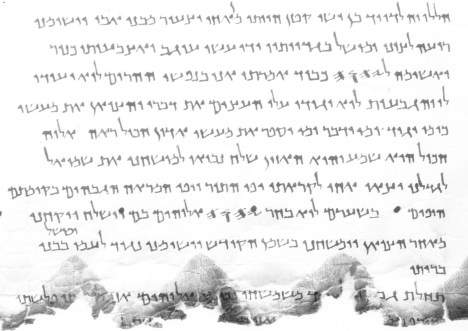
The discovery of the Great Psalms Scroll (11Q5) among the Dead Sea Scrolls in 1956, however, would radically transform our understanding of Psalm 151 as has been preserved in the Greek Septuagint. While most of the psalms preserved in the Great Psalms Scroll align with the Book of Psalms as currently constituted in our Bibles, it also included eleven additional psalms. And, just as Psalm 151 was presented at the end of the Book of Psalms in the Greek Septuagint, so also material consistent with Psalm 151 also concluded the Great Psalms Scroll. But the material was not exactly the same: “Psalm 151” in the Great Psalms Scroll was actually two different compositions which are now deemed Psalm 151A and Psalm 151B.
Translations of what we now call Psalm 151A and Psalm 151B from the Great Psalms Scroll (11Q5), along with translations of the other additional psalms, can be found at this PDF. It is immediately apparent how both Psalm 151A and Psalm 151B represent longer, more expansive poetic treatments of David’s origins; they also treat David’s anointing and David’s defeat of Goliath in separate compositions (the former the subject of Psalm 151A, the latter, of Psalm 151B).
What, then, would the relationship between Psalm 151A/B in the Dead Sea Scrolls and Psalm 151 in the Greek Septuagint, etc., look like? Some suggest that Psalm 151 as preserved in the Greek Septuagint ultimately had a Hebrew origin and was perhaps more “original,” and some later author divided up the material and expanded on it in order to create Psalm 151A/B in the Dead Sea Scrolls. But most scholars and analysts have come to the opposite conclusion: it seems more logical and sensible to conclude Psalm 151A and Psalm 151B were the original compositions, and for whatever reason, either a later author made a shortened, combined pastiche of quotes from them into a new Hebrew composition which was later translated into Greek, or perhaps the shortening and combination took place in the process of translating the text from Hebrew into Greek.
The substance of Psalm 151:1-7 as preserved in the Greek Septuagint and other versions, and even the more expansive Psalm 151A and Psalm 151B from the Great Psalms Scroll (11Q5), beyond a doubt, well concords with the narratives found in 1 Samuel 16:1-17:58. Nothing within these psalms, therefore, stand contrary to anything in Scripture.
Historically, most Orthodox traditions have accepted Psalm 151 as preserved in the Greek Septuagint and related versions as written by David himself and thus as canonical, inspired Scripture. Jewish people, Protestant Christians, and even the Roman Catholic Church, however, do not thus consider Psalm 151 as written by David, but consider it apocryphal and non-canonical in status. Psalm 151 can be found in many editions of the Old Testament Apocrypha, but not in all of them.
As we have seen, the discovery of Psalm 151A and Psalm 151B as part of the Great Psalms Scroll (11Q5) has transformed the entire discourse surrounding Psalm 151. Psalm 151 in the Greek Septuagint (LXX) and related versions now very much seems to represent an impoverished combination of Psalm 151A and Psalm 151B; if any of this material had any claim toward inspiration or even quality of substance, Psalms 151A and 151B would make for a far better case rather than Psalm 151 LXX.
Yet it would be most challenging theologically to make any kind of argument for the canonicity of Psalm 151A and Psalm 151B: while they most likely existed and were maintained by communities other than at Qumran, the texts were lost for the better part of two thousand years. How could anyone well and coherently argue how God truly did inspire the writing of Psalm 151A and Psalm 151B, allowed them to be lost in that form for millennia, but now should be reckoned among the rest of the psalms as inspired literature?
At the same time, the existence of Psalm 151A and Psalm 151B casts many aspersions against any kind of claim of inspiration or canonicity of Psalm 151 as translated in the Greek Septuagint and other versions. Yes, the existence of Psalm 151A and Psalm 151B refute the claim Psalm 151 LXX was an original Greek composition. But in order to argue for the inspiration and canonicity of Psalm 151 LXX, one must by necessity suggest Psalm 151A and Psalm 151B represent later expansions of a presumed Psalm 151 Hebrew original; otherwise, how could anyone well and coherently argue how a later pastiche is inspired and canonical but its original sources are not? And if one were to attempt to argue all of them are inspired and canonical, one would run into the same challenge as elaborated above regarding Psalm 151A and Psalm 151B. Ultimately one would still have to contend with how and why God would have the only truly inspired and canonical version be preserved in Greek and later translations while the Hebrew original was lost, with either the original entirely lost but a couple of expansions left in the caves at Qumran, or how the originals were lost but a later, conflated pastiche version was what God really wanted to have preserved and made canonical. Furthermore, the voices confessing Psalm 151 LXX as canonical and inspired have always been few, and most Christian traditions have always recognized the work as apocryphal, not actually from David, but from a later author writing as if David.
Yet above and beyond all these matters would be the matter of the substance of Psalm 151A/B/LXX. They all purport to be from David and would speak of how David was anointed and defeated Goliath; yet note well how David did not speak of his deeds like this in any of the canonical, inspired psalms presented in the Book of Psalms. The whole point of the Book of Psalms was to provide a voice for the people of God to sing and pray before God: David might well have written many psalms based on things he experienced, but wrote them all so that the people of God after him could appropriate the words and meaning for themselves. A psalm like Psalm 2:1-12 might really be intended to be sung at the installation of each successive king in the line of David, but its message worked for each one of those kings in turn, and was not specific to any one of them.
In this way Psalm 151A/B/LXX all stand outside the canonical, inspired Book of Psalms: it is about David himself, and does not represent a situation in which David was giving voice for the people of God to sing and pray to God for themselves. Perhaps this is why far more have believed Psalm 151 to be apocryphal than truly inspired and canonical: a Second Temple Jewish author wrote as if David, presenting a poetic version of the narratives in 1 Samuel 16:1-17:58 to celebrate David’s anointing and defeat of Goliath.
The story of Psalm 151, therefore, remains quite complicated. Arguments will no doubt continue regarding the relationship between Psalm 151A and Psalm 151B from the Great Psalms Scroll (11Q5) as Psalm 151 as translated in the Greek Septuagint and other versions. There is no reason to have any quarrel with any of the substance of any of these materials: they all well and accurately reflect the narratives found in 1 Samuel 16:1-17:58. Yet none of that means we should have any confidence David himself actually wrote either Psalms 151A and Psalms 151B or a presumed Hebrew original of Psalm 151 LXX. They provide a poetic re-telling of aspects of the story of David’s anointing and defeat of Goliath, but the psalms in the Book of Psalms are not about celebrating any individual’s accomplishments, but giving voice to the people of God to speak to God, and to give glory and praise to God for all He has done. If anything, Psalm 151 in any and all of its forms provide an effective contrast with the inspired, canonical psalms within the Book of Psalms, centering God our Creator who displays covenant loyalty, and not the deeds of any one person. May we accept Psalm 151 on its own terms as “outside the number” of the canonical, inspired psalms of the Book of Psalms, understand what it is, and allow the psalms God inspired to give us voice to speak to Him and encourage one another in Christ through the Spirit!
Ethan R. Longhenry


Leave a Reply